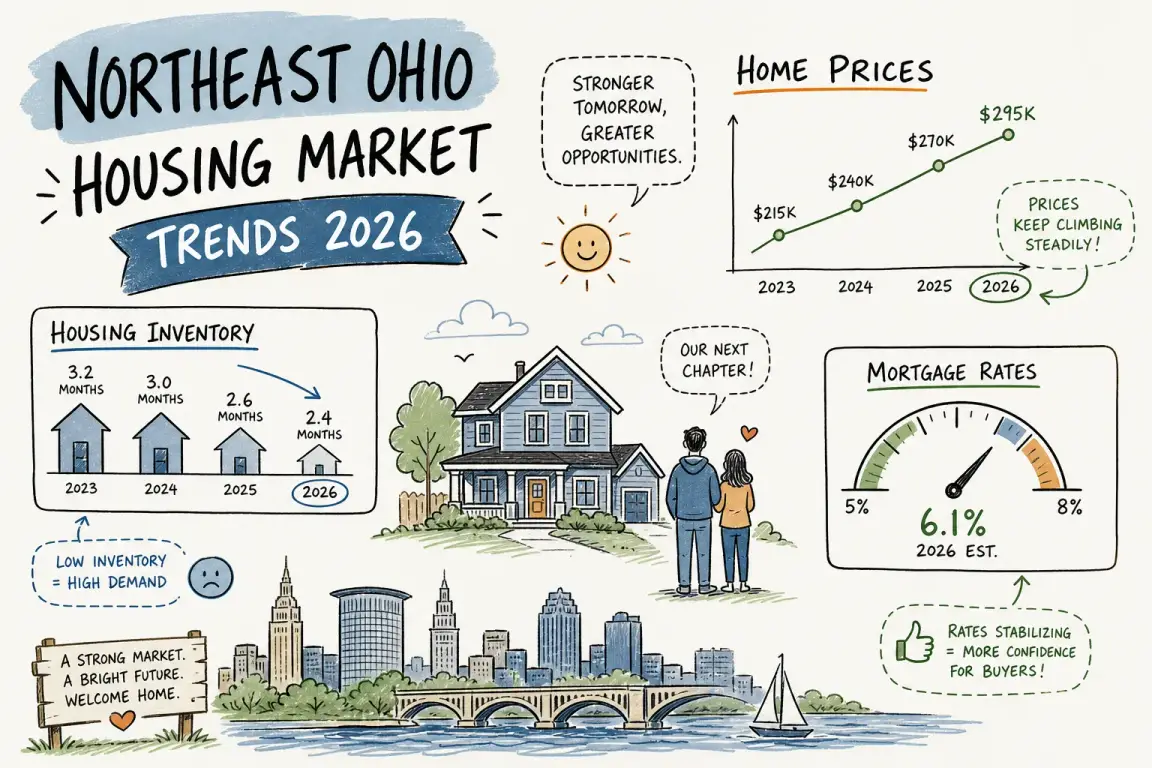

Northeast Ohio Housing Market Trends: A 2026 Breakdown
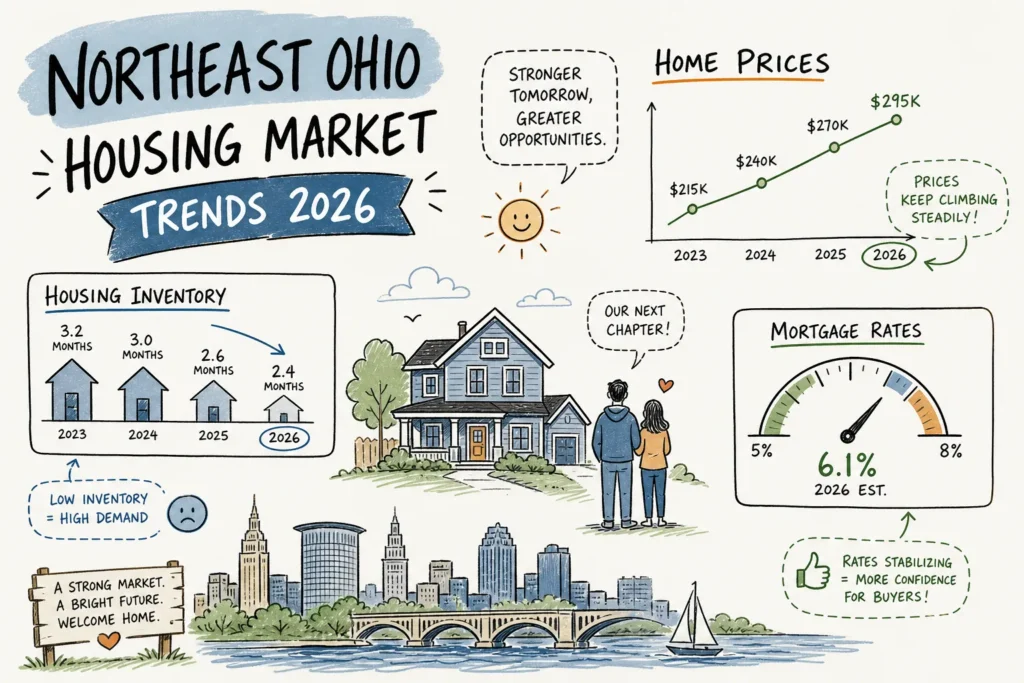
Northeast Ohio housing market trends in 2026 point to a region where prices are up across every major county, inventory has climbed roughly 13% in Cuyahoga County year over year, and days on market are creeping higher statewide, even as well-priced suburban homes still move in about three weeks. Metrics indicate a shift toward a more balanced market, not a collapsing one. And the county you’re buying or selling in matters far more than any regional headline number.
Damien Baden at Realty Done by Damien Baden has tracked these shifts across Cuyahoga, Summit, Lorain, Medina, and Stark Counties throughout his real estate career. The numbers tell one story; the hyperlocal conditions inside those numbers tell another. This breakdown covers both: median prices by county, inventory and days-on-market changes, how Cleveland stacks up nationally, what mortgage rates are doing to buyer behavior, and clear next steps for buyers and sellers right now.
Key takeaways
- Prices still rising: Every major Northeast Ohio county posted year-over-year gains in 2026, with Medina County leading at 11.7% and Cuyahoga close behind.
- Inventory is up but tight: Cuyahoga County active listings grew roughly 13% year over year, giving buyers more choices without tipping into a true buyer’s market.
- Cleveland outpaces the nation: Multiple national indices ranked Cleveland third or fourth for annual price growth in 2026, with appreciation running 2 to 4 percentage points above the national average.
- Rates crossed 7%: Ohio’s 30-year fixed rate hit approximately 7.4% in October 2026, cutting purchasing power and shifting leverage toward buyers on slower-moving listings.
- County-level data is what matters: A single regional number masks wide variation. Based on mid-2026 MLS data, Medina’s median is approximately $155,000 higher than Summit’s.
- Fundamentals support prices: A projected shortage of 9,499 housing units per year through 2031 means Northeast Ohio prices have structural support even as demand softens.
Northeast Ohio housing market trends: what are home prices actually doing county by county?
Medina and Cleveland lead the region with double-digit gains
Medina County posted the strongest annual appreciation of any county in the region, with its median sale price reaching $393,889, an 11.7% year-over-year increase as of June 2026. That growth is not an accident. Medina draws buyers who want strong school districts, larger lots, and suburban quiet without the premium of the inner-ring Cuyahoga suburbs, and new construction there remains limited enough that existing inventory carries real pricing power.
Cleveland city’s median sale price of $149,929 looks modest in absolute terms, but the 10.6% three-month appreciation rate tells the real story. The city’s low baseline means percentage gains compress quickly. Buyers entering now are still getting in well below what comparable urban markets cost nationally, but the window on that entry price is narrowing faster than many expect.
The steady middle: Summit, Lorain, and Stark counties
Summit County came in at $239,325 with a more modest 0.8% annual gain, while Lorain County reached $294,669 at 3.2% growth, and Stark County hit $249,197 with a 5.8% increase. These three counties represent the value tier of the region: slower appreciation, more accessible entry points, and generally lower price-per-square-foot than the closer-in Cuyahoga suburbs, based on local MLS comparisons.
Lorain and Stark in particular attract buyers who are getting priced out of Cuyahoga or who simply want more house for their money. Prices in these counties can run tens of thousands of dollars lower than comparable Cuyahoga suburban listings. That calculus becomes more compelling every month that rates stay elevated and monthly payments remain stretched.
How Cuyahoga County’s countywide number differs from the Cleveland city figure
Cuyahoga County’s countywide median sits at $250,000, up 2.04% year over year, a number that looks sluggish until you dig into it. A separate first-half 2026 analysis of combined Cleveland and suburban sales showed a $195,000 median up 10% from the prior year, while suburban single-family and condo medians reached $236,400, also up 7%. These figures differ based on what each dataset includes: time periods, geographic boundaries, and whether distressed sales are counted.
The practical takeaway is that one number cannot describe Cuyahoga County’s housing market. A zip code in Westlake and a zip code in East Cleveland are both technically “Cuyahoga County.” Pricing decisions, offer strategies, and investment calculations all require a layer deeper than the county average.
| County | Median sale price (2026) | Year-over-year change |
|---|---|---|
| Medina | $393,889 | +11.7% |
| Lorain | $294,669 | +3.2% |
| Cuyahoga | $250,000 | +2.04% |
| Stark | $249,197 | +5.8% |
| Summit | $239,325 | +0.8% |
| Cleveland (city) | $149,929 | +10.6% (3-month) |
Inventory and days on market, northeast Ohio housing market trends heading into fall 2026
Active listings are rising but the market is not flooded
Cuyahoga County’s active listings grew from approximately 2,163 in April 2025 to just over 2,450 by April 2026, a gain of roughly 13%. Across Ohio as a whole, statewide inventory jumped from 17,234 listings in April to 23,302 by August 2026, a 35% increase over that stretch. Those numbers sound dramatic, but context matters. The starting point was historically tight. A 13% increase from a historically low floor does not create a buyer’s market; it creates a market with slightly more breathing room.
Buyers now have more options than at any point since at least spring 2025, and in many submarkets this represents the most supply seen in two to three years. Multiple offers are less automatic on mid-range listings, and concessions are reappearing in negotiations. That shift is real and worth acting on, but it is not the same as prices being soft or sellers being desperate.
Days on market: Cuyahoga moves fast, Ohio as a whole does not
Cuyahoga County’s median days on market ran around 21 days in spring 2026, with broader countywide figures settling near 40 to 43 days by August, depending on methodology. Ohio’s statewide median rose from 37 days in May to 45 days in September 2026. The gap between those numbers reflects what is actually happening: the strongest Cuyahoga suburbs are still selling fast, while softer submarkets across the state are sitting longer.
A well-staged, well-priced home in a strong Cuyahoga suburb still attracts serious buyers within weeks. A home that needs work or sits at an aspirational price point in a slower submarket is a different story entirely. Pricing to current comparables rather than last year’s peak is the single biggest factor separating a three-week sale from a 45-day listing in this market.
How does Cleveland’s price growth compare to national markets?
Cleveland ranked fourth among major U.S. markets for annual price growth
In August 2026, Cleveland’s median sale price rose 6.4% year over year, versus 2.1% nationally, ranking the city fourth among the 40 largest U.S. markets according to Homes.com. That translated into roughly $16,500 in equity gain for the typical Cleveland buyer in a single month, compared to approximately $8,000 nationally. The Redfin Home Price Index also placed Cleveland fourth for June, while Case-Shiller ranked the city third in its 20-city index through April 2026, reflecting a 4.2% annual gain.
This is not a one-month spike. Multiple indices, multiple months, and multiple methodologies all point to the same pattern: Cleveland is outpacing the national housing market consistently in 2026.
Why Cleveland outperforms when rates are high
Cleveland’s August median of $273,000 sits roughly 31% below the national median of $395,000. That gap is not a weakness, it is a structural advantage in a high-rate environment. When a 7% mortgage is applied to a $270,000 home instead of a $400,000 one, the monthly payment remains manageable for a larger pool of households. Buyers who are priced out of Phoenix, Nashville, or coastal markets can still qualify in Cleveland, and they are doing exactly that.
PNC’s 2026 forecast put Cleveland-area price growth at 3.6%, well above its estimated national increase of around 0.7% for the same comparison period. Affordable markets do not just survive rate increases; they absorb buyers that expensive markets shed. Northeast Ohio is benefiting from that dynamic directly.
What are mortgage rates and the local economy doing to buyer demand?
Rates crossed 7% by October, and buyer behavior shifted quickly
Ohio’s 30-year fixed rate hit approximately 7.4% to 7.53% by mid-October 2026, up from 6.66% in late August. Freddie Mac’s national average for the week of October 15 came in around 7.40%. The move from 6.66% to 7.03% alone reduced a typical buyer’s purchasing power by roughly $11,500, and rates kept climbing from there. National purchase-mortgage applications were 16% below the prior year by that point, and home visits fell 20% year over year in September.
For a Northeast Ohio buyer, this means the same monthly payment buys meaningfully less house than it did two months ago. Sellers who understand this shift are pricing ahead of it; those who don’t are watching their listings sit while buyers quietly shop elsewhere. The buyers who remain active are negotiating harder: seller-paid rate buydowns, repair credits, and price adjustments are all back on the table in ways they weren’t in 2024.
What local jobs, household formation, and construction permits tell us
Demand has slowed, but it has not collapsed, and the reason is rooted in Northeast Ohio’s fundamentals. The region needs an estimated 9,499 new housing units per year through 2031 to keep pace with household formation. Regional household counts are projected to grow from 888,103 in 2026 to 900,481 by 2031. Owner-occupied vacancy sits at just 0.7%, and rental vacancy at 5.3%, both below stable benchmarks. The shortage is real.
The lock-in effect compounds the supply problem. Existing homeowners with sub-4% mortgages have little incentive to sell and replace their loan with one above 7%. That keeps listings off the market even as buyer demand softens, which is a large part of why prices have held despite weaker activity. The Northeast Ohio housing market is not heading for a correction; it is navigating a constraint that affects supply and demand simultaneously.
Akron housing market update and what it means for the broader region
The Akron market, the core of Summit County, reflects the broader northeast Ohio housing market trends playing out across the region’s mid-tier counties. With Summit County’s median at $239,325 and annual appreciation at just 0.8%, Akron proper offers some of the most accessible price points in the metro area. Inventory has loosened marginally, and days on market are trending longer than in the tighter Cuyahoga suburbs, giving buyers a bit more room to negotiate. For households priced out of Cleveland’s stronger zip codes, Akron continues to represent a realistic entry point with solid long-term fundamentals tied to the same regional supply shortage driving prices elsewhere.
What should buyers and sellers actually do with this data?
Sellers: this market still rewards preparation and smart pricing
Sellers who treat 2026 like 2022 are going to get a rude awakening. With statewide DOM rising and buyer traffic down, the homes moving clean and fast share three things. First, accurate pricing from day one based on current comps, not last spring’s peak. Second, strong presentation that removes buyer hesitation. Third, marketing that puts the listing in front of the right buyers from the start, not a passive MLS upload and a lockbox.
At Realty Done by Damien Baden, that means a targeted digital marketing strategy built for maximum exposure. Damien’s years of reading Cuyahoga and surrounding county conditions mean pricing conversations are grounded in what the current market will bear, not what a seller hopes it will. Sellers who price to test the market above comps are increasingly paying for that decision in extended DOM and eventual reductions that net them less than a sharp initial price would have.
Buyers: more options, more leverage, and when to move
With inventory up 13% and DOM rising, buyers have more negotiating leverage than they have had in several years. Seller concessions are back. Rate buydowns are on the table. Inspections and contingencies are no longer automatic dealbreakers in most price ranges. That is a meaningful shift from 2021 to 2023, and buyers should use it.
The nuance is this: well-priced, well-located homes in Cuyahoga County’s strongest suburbs are still closing in about three weeks. Waiting for a discount on a premium property in Medina or a top-rated school-district suburb usually backfires. The strategy is to get pre-approved, define your target submarket with county-level precision, and move decisively when the right home shows up. Working with a team that knows how Cuyahoga conditions differ from Summit or Lorain conditions is not optional when the market varies this much from one zip code to the next.
The bottom line on Northeast Ohio housing market trends in 2026
Northeast Ohio housing market trends in 2026 point to a region appreciating faster than the national average, carrying more inventory than last year, and cooling just enough to shift leverage back toward buyers in certain submarkets. Prices are not falling. The fundamentals supporting those prices, a real housing shortage, strong affordability relative to national markets, and steady household formation, are not going away.
The county-level and suburb-level data is what matters here. A single regional number is a starting point, not a strategy. The difference between a smart decision and a costly one often comes down to understanding what is happening in your specific submarket right now, not what happened regionally last quarter.
Whether you’re buying or selling across the Cleveland metro, Cuyahoga, Medina, or Summit County, reach out to Realty Done by Damien Baden for a straight read on what the current numbers actually mean for your specific situation. No sugarcoating, no guesswork, just deep Northeast Ohio market experience applied to your specific numbers, not a regional average.
Frequently Asked Questions
Is now a good time to buy in Northeast Ohio given current inventory and rates?
Yes, buyers have more options and more negotiating leverage than they did a year ago. Inventory in Cuyahoga County rose roughly 13% year over year and statewide listings climbed 35% from April to August 2026, while days on market have crept higher and seller concessions, rate buydowns, and repair credits are reappearing for motivated buyers.
Are home prices likely to fall in Northeast Ohio right now?
No, prices are holding and in many counties are still rising. Every major county posted year-over-year gains in 2026, fundamentals like an estimated annual shortage of 9,499 housing units through 2031 and low vacancy rates support prices, and multiple national indices showed Cleveland outpacing national growth.
How much did recent mortgage rate increases reduce a typical buyer’s purchasing power?
The move from 6.66% to 7.03% reduced a typical buyer’s purchasing power by roughly $11,500. Rates climbed further into the 7.4% range by mid-October 2026, which tightened affordability and shifted leverage back toward buyers on slower listings.
Should sellers expect to offer concessions or price reductions this market?
Some sellers should expect to be more flexible, but well-prepared listings still sell quickly. Homes that are accurately priced, well staged, and marketed tend to move in about three weeks in strong Cuyahoga suburbs, whereas listings priced above current comps or poorly presented are seeing longer days on market and may need concessions or reductions.
How different are median prices between counties in this region?
County medians vary a lot, Medina’s median in mid-2026 is about $155,000 higher than Summit’s. For example, Medina’s median is $393,889 (up 11.7%) versus Summit at $239,325 (up 0.8%), with Cuyahoga at $250,000 and Cleveland city at $149,929, so county- and zip-level data matter greatly for decisions.
To find out more about housing market trends in Northeast Ohio, contact us here today or call/text 440-530-7052
You may find these Realty Done by Damien Baden links helpful
Realty Done By Damien Baden Listings
50 Tips To Sell Your Home Fast in Northeast Ohio
How to win in a multiple offer situation
No BS Home Buying Your Home Buyers Guide
New Construction Home Loans In Ohio
Do you need a realtor when buying new construction?
Realty Done by Damien Baden Client Reviews
Why Use An Agent When Buying Or Selling Your Northeast Ohio House?
