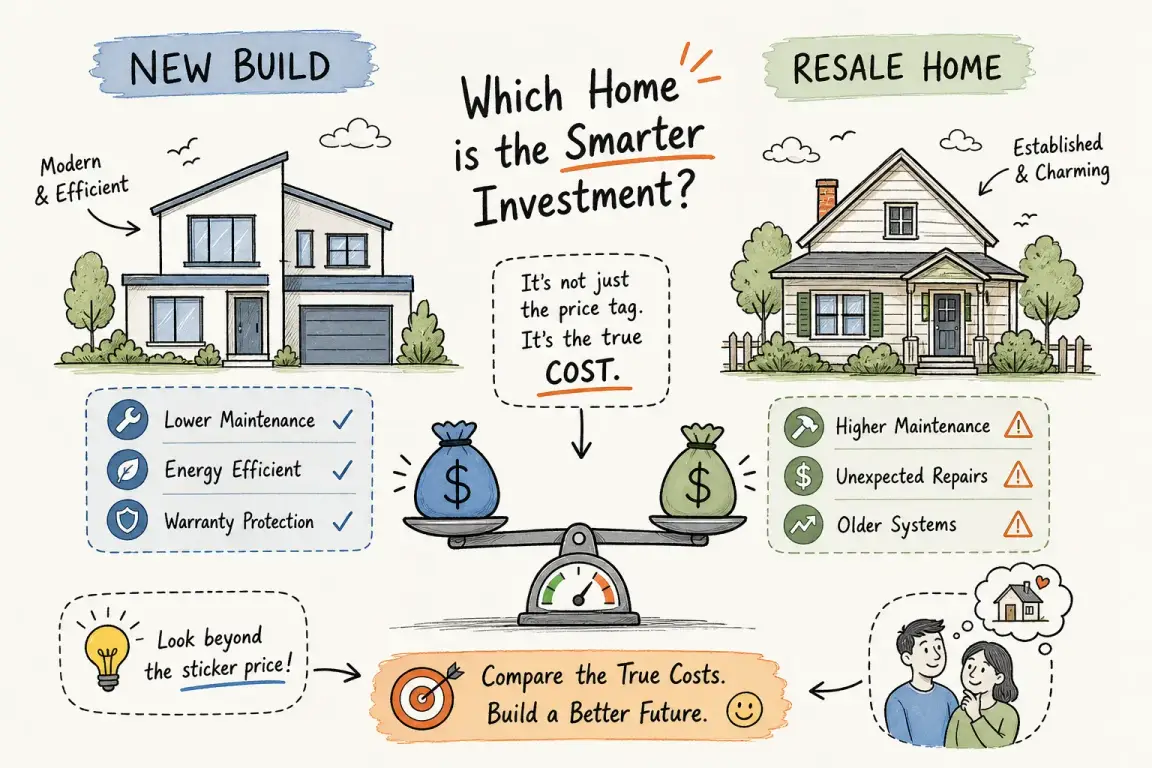

New Build vs. Resale Home: The 2026 Buyer’s True Cost Guide
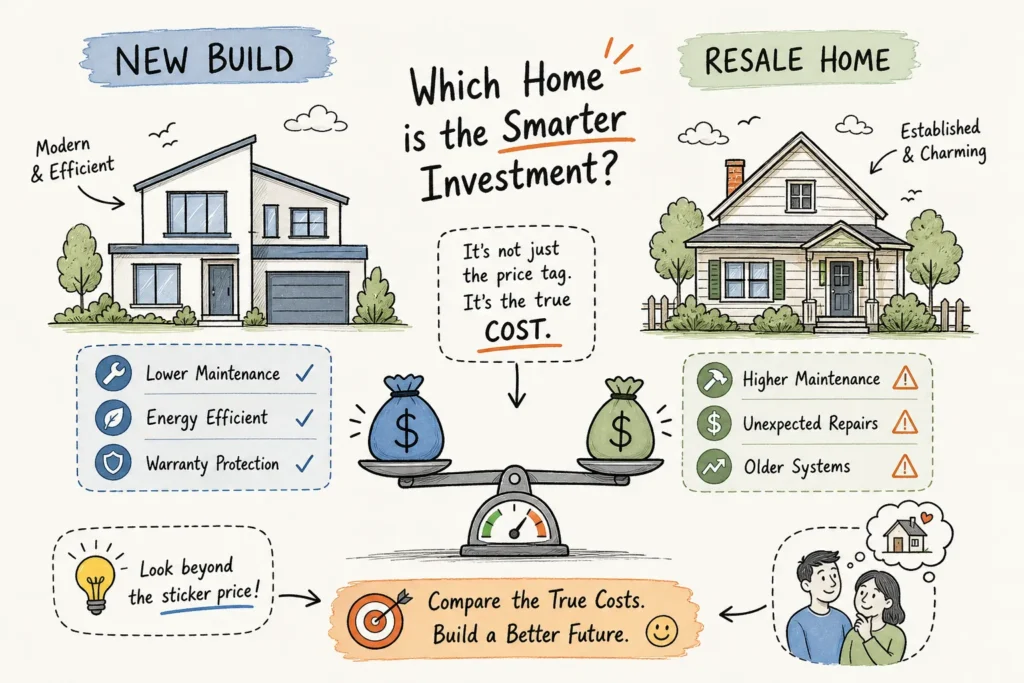
Every buyer hits this wall at some point: a brand-new home sounds appealing because nothing’s broken, nothing’s worn, and nobody lived there before you. But then you look at a resale home in a neighborhood with mature trees, established schools, and a list price that fits the budget better. The problem isn’t that one option is objectively better. The problem is that many buyers are comparing the wrong things when they weigh a new build vs. a resale home. At Realty Done by Damien Baden, this crossroads comes up constantly before clients place an offer, and the decision gets made badly more often than it should.
Builder brochures are designed to sell you on the new-build lifestyle. “As-is” disclosures on resale homes are designed to limit seller liability. Neither document gives you the full picture. What you actually need is a side-by-side look at real costs, real risks, and the trade-offs that matter to your specific situation. That’s exactly what this guide delivers. By the end, you’ll have a clear framework to make the right call between a newly constructed home and an existing property, with no fluff and no guesswork.
New Build vs. Resale Home: 2026 True Cost Comparison
The 2026 median price gap explained
Here’s the number that surprises most buyers: new construction is not categorically more expensive than resale. In Q1 2026, the national median price for a new home sits at approximately $403,200 versus $404,600 for an existing home. On a per-square-foot basis, new builds come in at roughly $205 compared to $212 for resale properties. That’s a 3.3% discount per square foot in favor of new construction, which flips the assumption most buyers walk in with.
That national snapshot doesn’t apply everywhere, and you need to understand that before drawing conclusions. In low-inventory markets, new construction can carry a meaningful premium. In high-supply Sun Belt metros where builders are moving volume, discounts are common. Northeast Ohio has its own market context, where builder activity in communities like Medina and Strongsville follows different pricing patterns than national averages suggest. Your agent needs to pull local comps, not national headlines, before you make any assumptions about which option costs more in your target area.
How builder incentives and rate buydowns affect the real number
The sticker price is only part of the equation. Builder incentives in 2026 are widespread: roughly 13.8% of builder listings carry some form of reduced-rate promotion, and about 4.8% offer flex cash credits. Common packages include 2-1 rate buydowns, closing-cost credits ranging from a few thousand to tens of thousands of dollars, design center allowances, and quick-move-in discounts on completed homes. When you stack these on top of a base price that’s already competitive with resale, the gap narrows even further.
What to watch when a builder pushes its preferred lender
Builder-affiliated lenders originated about 35% of new construction loans in recent years, and some large builders report capture rates of 70-85% when their incentive packages are involved. The risk is real: a $10,000 closing credit paired with a rate that’s just 0.25 percentage points higher can add $18,000-$20,000 in lifetime interest on a $350,000 loan. Always request official Loan Estimates from the builder’s lender and at least two independent lenders, then compare APR, total fees, and cash to close, not just the advertised monthly payment. A builder cannot legally require you to use their lender to purchase the home. They can, however, tie optional incentives to that choice, so understand exactly what you’re trading before you agree.
New Build vs. Resale Home: Warranties and Inspection Risk
The 1-2-10 warranty: what it covers and where it stops
New construction wins most convincingly here, at least on paper. Most production builders offer a tiered 1-2-10 warranty structure: one year on workmanship and materials, two years on major systems like plumbing, electrical, and HVAC, and up to ten years on structural components including the foundation, load-bearing walls, and roof framing. That coverage provides real budget predictability during the years when a resale home is most likely to surprise you with a repair bill.
The exclusions matter just as much as the coverage. Builder warranties typically don’t cover normal wear, cosmetic settling like minor drywall cracks or nail pops, landscaping and drainage problems caused by grading changes after closing, appliance failures covered under manufacturer warranties, or any defect you fail to report within the builder’s specified notice window. Read the actual warranty document before closing, not the marketing summary. Confirm the start date, reporting deadlines, and dispute resolution process.
Common repair costs resale buyers face in the first five years
Resale buyers should plan for a realistic repair reserve, not just budget for the list price. A practical planning range is $10,000-$15,000 in total repairs within the first three to five years for a typical resale home, with older or poorly maintained properties running $25,000 or more. The most frequent inspection findings carry real cost ranges worth knowing:
- HVAC replacement: $5,000-$15,000
- Roof repairs or replacement: $400-$14,500 depending on scope
- Electrical panel or rewiring: $2,400 for a panel, $10,000-$16,000+ for full rewiring
- Plumbing leaks or repiping: a few hundred dollars to $12,000
- Water intrusion or mold remediation: $1,000-$30,000 depending on severity
How to size a repair reserve before making an offer
Separate your inspection findings into three buckets: immediate safety or active water issues, repairs likely within one to three years, and routine maintenance items. Get specialist bids on any roof, foundation, HVAC, sewer line, or electrical concern before you remove contingencies. An inspection report identifies conditions; it doesn’t tell you what a contractor will charge to fix them. Buyers who skip that step often hit the 12-month mark with a five-figure repair they didn’t budget for. Getting those bids in hand before you finalize negotiations is the move that separates prepared buyers from reactive ones.
Customization, Timelines, and What “Move-In Ready” Really Means
The design center reality: custom doesn’t mean unlimited
New construction gives you a meaningful say in finishes, flooring, countertops, and certain layout options. That’s real value, especially for buyers who’ve spent years looking at dated resale kitchens. But the design center operates within a defined selection list, builder-set pricing, and a budget that can run away quickly. Design center upgrades typically add 10-20% above the base price. On a $400,000 home, that’s $40,000-$80,000 in additional costs before you’ve paid for landscaping, fencing, or window treatments.
Build timelines and the rate-lock exposure buyers underestimate
From contract signing to closing, a production or subdivision home in 2026 typically takes 8-12 months, with nine to ten months being a reasonable planning estimate. Custom and semi-custom builds often run 12-18 months or longer. During that window, your rate is exposed to market movement unless you’ve locked early, and most standard locks only cover 30-90 days. Ask the builder for a contractual completion window, not just a best-case date. Understand how delays are handled before you sign anything.
Neighborhood maturity as a real factor in resale’s favor
New construction communities in developing suburbs offer a clean slate but not much else yet. Infrastructure is often still catching up, nearby businesses may be sparse, landscaping is new, and HOA fees in Northeast Ohio’s newer subdivisions typically run $100-$300 per month for a detached home, sometimes higher when amenities are included. Resale properties drop you into established neighborhoods with existing school district track records, mature trees, nearby services, and a community character you can evaluate before you buy. For buyers with school-age kids or a need for neighborhood walkability, that’s a concrete advantage worth factoring into the comparison.
The Hidden Costs That Catch Buyers Off Guard
What new construction buyers forget to budget before closing
Builder base prices almost never include landscaping, fencing, or window treatments. Those costs hit immediately after you move in. Design center upgrades carry builder markups that can exceed what you’d pay to have the same work done independently after closing, so some buyers intentionally skip selections and hire their own contractors post-closing. Factor those costs into your true purchase price calculation before you compare new construction to a resale alternative.
Five-year utility and maintenance cost comparison by home type
New construction homes typically cost $500-$1,500 per year in routine maintenance during the first five years. A typical resale home runs $2,000-$10,000 or more annually, heavily influenced by age and condition. On utilities, new builds benefit from better insulation, modern HVAC, efficient windows, and tighter air sealing. Estimated annual energy costs for a new home run roughly $1,800-$2,400 compared to $3,000-$4,200 for a pre-2000 resale home of similar size. That gap runs $600-$1,800 per year. Over five years, that utility difference alone can run $3,000-$9,000 in favor of new construction, before you account for avoided major repairs.
The inspection report is not a repair bid: how to read it right
Resale buyers consistently make the same mistake: they treat a long inspection report as a deal-killer or, worse, as proof that the price is already justified. An inspection report is a list of conditions observed on a single day by a generalist. It doesn’t tell you what the roof has left in it, whether the foundation movement is stable, or what a licensed plumber will charge to fix that slow drain. After the general inspection, follow up with specialists on any system that’s within five years of its typical lifespan or showing visible stress. That’s the information you actually need before you negotiate price or credits.
Why Your Buyer’s Agent Matters More Than the Home You’re Buying
What the builder’s sales rep isn’t telling you
Builder sales representatives are employed by the builder. Their job is to sell that specific home at or above list price, with contract terms that protect the builder’s schedule and profit margin. They’re professional, often helpful, and completely focused on the builder’s interests. That’s simply the structure you’re walking into when you visit a model home without your own representation. Builder contracts come pre-written with loosely defined delivery timelines, favorable earnest money terms for the builder, and upgrade pricing that has little flexibility without the right representation across the table.
New construction contracts: where an experienced agent earns their value
An agent with actual new construction experience knows which concessions builders will move on: lot premiums, closing cost credits, quick-move-in upgrade packages, and contract language around delivery delays and earnest money refunds. Damien Baden built his expertise working directly in new construction sales before founding his team, which means he’s reviewed these contracts from both sides of the table. That perspective matters when you’re working through a 40-page builder contract and trying to figure out which lines are negotiable and which ones aren’t.
Resale negotiation vs. builder negotiation: two different skill sets
On the resale side, leverage comes through a different set of tools: inspection findings that justify price reductions or repair credits, comparable sales that challenge an inflated list price, and closing timeline flexibility that can make your offer more attractive than a competing bid. Neither environment is passive. Going into a builder’s sales office without your own representation can cost you far more than the agent’s commission, whether through above-market financing, non-negotiated contract terms, or upgrade pricing you didn’t have to accept. The same is true of making an offer on a resale property without an agent who knows how to use an inspection report as a negotiating document.
How to Make the Final Call: A Short Decision Framework
The four questions that clarify which path fits your life
Before you compare listings side by side, answer these four questions honestly:
- How soon do you need to move? If your timeline is inside six months, new construction is likely off the table unless you’re targeting quick-move-in inventory.
- How much repair risk can your budget absorb in year one? A buyer with limited cash reserves after closing has less room for a resale home’s early surprises.
- Does customization justify a longer wait and design center costs? Be honest about how much those finish choices actually matter to your daily life.
- Is the resale price discount large enough, after a realistic repair reserve, to actually pencil out better than the new-build alternative? Run the real numbers, not the best-case scenario.
When new construction wins, and when resale makes more sense
New construction wins when budget predictability matters more than neighborhood maturity, when you have the timeline flexibility to wait out a build, and when builder incentives are meaningful enough to offset the design center and landscaping costs you’ll absorb after closing. Resale wins when you need to move quickly, when the location is irreplaceable, when a recently renovated home’s systems are young enough that the repair reserve is modest, or when the price discount is large enough to fund both a reserve and potential updates. The decision comes down to timing, budget predictability, and risk tolerance, not just square footage and finishes.
If you’re still working through the new build vs. resale home decision with real Northeast Ohio numbers, the Realty Done by Damien Baden team is the practical next step. Damien and his team have worked both sides of this transaction across the region, and they’ll give you a straight read on which path fits your situation. No builder spin, no generic pitch. Reach out for a no-nonsense consultation before you commit to either direction.
To find out more about new build vs. resale homes in Northeast Ohio, contact us here today or call/text 440-530-7052
You may find these Realty Done by Damien Baden links helpful
Realty Done By Damien Baden Listings
50 Tips To Sell Your Home Fast in Northeast Ohio
How to win in a multiple offer situation
No BS Home Buying Your Home Buyers Guide
New Construction Home Loans In Ohio
Do you need a realtor when buying new construction?
Realty Done by Damien Baden Client Reviews
Why Use An Agent When Buying Or Selling Your Northeast Ohio House?
