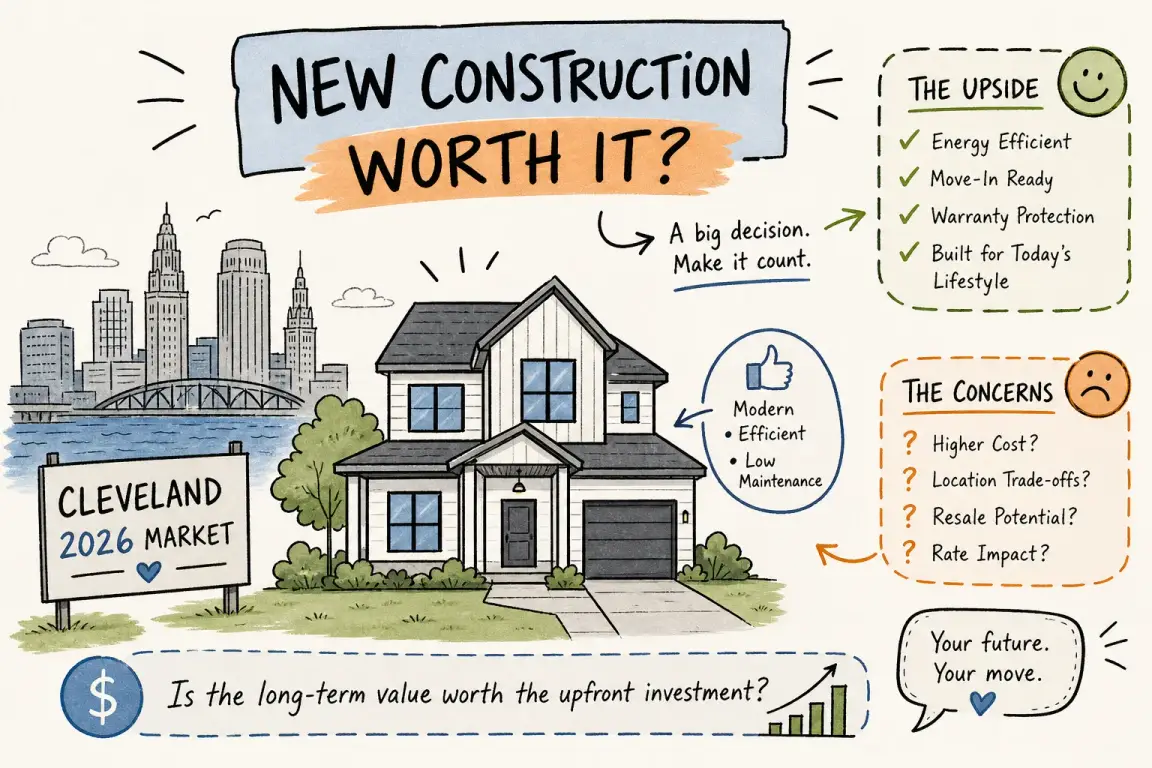

Is new construction worth it in Cleveland’s 2026 market?
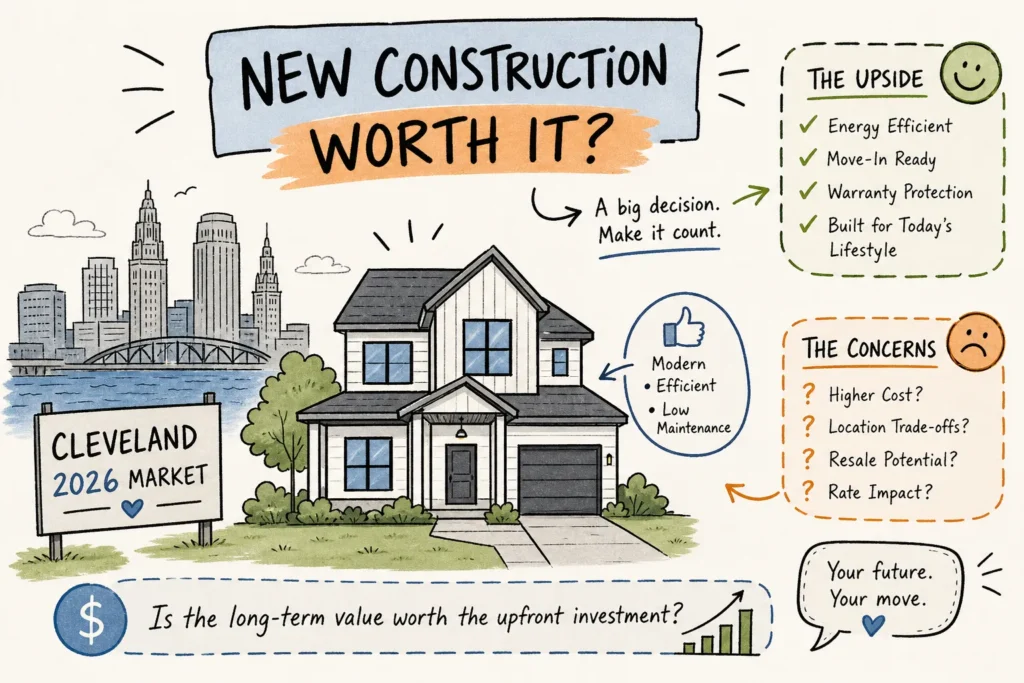
Is new construction worth it in the Cleveland area in 2026? The honest answer: it can be, but only if you go in with accurate numbers and realistic expectations, not the builder’s brochure version. For a 2,000-square-foot mid-range home, you’re looking at $310,000–$370,000 in construction costs alone before land, upgrades, permits, or lot premiums. Custom builds in Cuyahoga County push closer to $390,000 at that same square footage. In suburbs like Strongsville or Avon, a comparable existing home can often be purchased for less and may appreciate just as well, depending on neighborhood demand and school district strength. That doesn’t make new construction the wrong choice; it makes it a decision that demands a real cost comparison, not marketing math.
This guide breaks down actual 2026 numbers for Cleveland-area new builds: price per square foot, what builder incentives actually deliver, where contracts trip buyers up, and how resale value compares over time. By the end, you’ll have a clear framework for deciding whether a new home fits your budget and goals.
Key takeaways
- True cost runs higher: Mid-range new construction in Cleveland costs $155–$185 per square foot, excluding land, lot premiums, permits, and upgrades; budget $170–$200 per square foot as a safer planning floor.
- Incentives come with strings: Builder credits of $5,000–$15,000 typically require using the builder’s preferred lender and title company; always compare the net APR against an outside quote.
- Contracts favor the builder: Ohio new construction agreements are drafted by builder attorneys and contain delay clauses, arbitration requirements, and limited buyer exit rights.
- Timeline is 12–18 months: From finalized design to occupancy, plan for at least a year, sometimes closer to two, with carrying costs and rate-lock risk built in.
- Location drives appreciation: The Cleveland metro gained 52.7% over five years, but a new build in a low-demand neighborhood won’t inherit a strong neighborhood’s trajectory.
- A buyer’s agent costs you nothing: In most Cleveland-area new construction deals, builders cover the buyer’s agent commission, verify the arrangement in writing, but there’s typically no financial reason to walk into a model home without representation.
What does new construction really cost in the Cleveland area?
Price per square foot: the number builders don’t lead with
The 2026 mid-range estimate for Cleveland sits at $155–$185 per square foot for builder-grade construction, excluding land. On a 2,000-square-foot home, that translates to $310,000–$370,000 in construction costs before you’ve paid for the lot, permits, or a single appliance. Custom builds in Cuyahoga County run closer to $195 per square foot, pushing the same 2,000-square-foot home toward $390,000 before any site costs.
The phrase “excluding land” does real damage to buyer budgets when it’s glossed over. In suburban markets like Avon and Strongsville, lot premiums alone can add $25,000–$60,000 or more, these are planning-range estimates that vary significantly by community and lot position, not published averages. Use $170–$200 per square foot as your planning floor before site work, and you’ll avoid the shock of a final budget that’s 20% higher than the model-home brochure suggested.
The real costs buried in the base price
Permit fees typically run $1,500–$8,000 depending on the municipality, and that’s before separate plumbing, electrical, and HVAC permit costs. Add utility connections, landscaping, window coverings, and HOA initiation fees, and the gap between the advertised base price and your actual all-in number grows fast. None of these line items are unusual; they’re just not included in what the builder advertises.
With an existing home, most of these costs are already baked into the listing price. The yard is landscaped, the blinds are up, and the appliances are often staying. That’s a meaningful budget advantage that doesn’t show up in a simple price-per-square-foot comparison.
Do builder incentives actually save you money?
Closing-cost credits and rate buydowns: read the fine print
Cleveland-area builders commonly offer $5,000–$15,000 in closing-cost credits, plus temporary 2-1 buydowns or permanent rate reductions of roughly 0.5–1.5 percentage points through their preferred lender. Those numbers look meaningful on paper. The catch is that most incentives are contingent on using the builder’s preferred lender and title company, which removes your leverage to shop for better terms.
Before you accept any incentive package, get a competing loan quote from an outside lender and compare APR, origination fees, and required services side by side. In many cases, the “savings” from the builder’s rate buydown are partially or fully offset by higher lender fees. The right question isn’t how much you’re getting; it’s what your net cost looks like compared to a comparable existing home with competitive financing.
Upgrade packages: value add or margin play?
Design-center credits typically range from $5,000 to $25,000 for flooring, cabinets, countertops, and fixtures. What builders don’t advertise is the markup: production builder design centers commonly charge 50%–100% more than an independent contractor for the same finishes, with some categories like lighting and cabinet upgrades running 80%–200% above comparable market pricing. A $20,000 design-center allowance may represent only $7,000–$10,000 in real-world material and labor value.
Quick-move-in discounts on standing inventory can reach $5,000–$40,000 or more, and those are often the better deals because the home is priced to move. Evaluate them honestly: does the included spec match what you’d choose, and have lot premiums, missing appliances, and landscaping been factored in?
The one exception to post-closing contractor work is structural, electrical, and plumbing changes. These are almost always cheaper done during construction than retrofitted later.
What builder contract pitfalls catch buyers off guard?
Contract clauses that are written for the builder, not for you
Ohio new construction purchase agreements are not negotiated documents in the traditional sense. They’re drafted by builder attorneys and structured to protect builder interests. Common problem clauses include estimated (not firm) closing dates with no outside deadline, broad force majeure language that can cover delays of any length, and “no damages for delay” provisions that bar buyers from recovering rent, storage, or rate-lock extension costs while the build runs over schedule.
Many agreements also include mandatory arbitration clauses that remove your ability to pursue warranty disputes in court, nonrefundable deposit provisions that activate quickly, and release language at closing that waives claims you could have asserted before signing. Buyers often don’t realize some of these terms are negotiable, particularly around buyer termination rights and deposit protection if the builder misses the outside date. An Ohio real estate attorney should review the contract before you sign anything.
Why having a buyer’s agent with builder-side experience matters
Many buyer’s agents have limited direct experience with builder contracts. They know resale transactions well, but that knowledge doesn’t fully transfer to a process designed by a builder’s sales and legal team. Damien Baden of Realty Done by Damien Baden brings hands-on new construction sales training to the table, experience gained from working inside builder communities, not just reviewing contracts after the fact.
That background means catching problematic clauses before they create costly surprises, negotiating upgrade concessions, and advocating for your interests in a process structurally designed to favor the builder. A buyer’s agent in a new construction deal is typically paid by the builder, confirm the commission arrangement in writing, but in most Cleveland-area transactions there’s no cost to you. There’s no financial reason to walk into any model home without one.
How does new construction resale value hold up in Cleveland?
What the appreciation data actually shows
The FHFA Cleveland metro index rose 52.7% from 2020 through 2025, roughly 8.8% annually. That’s a strong five-year run by any measure. However, this covers the entire market, not new construction specifically: a clean new-construction-only resale index for Cleveland doesn’t exist in public data. The honest conclusion is that the broader market has been healthy, but new construction doesn’t automatically outperform existing homes on appreciation.
New builds often underperform in the early resale years because the original builder premium fades while the builder is still selling competing homes nearby. After a development builds out, appreciation generally converges with the surrounding market. Existing homes in supply-constrained neighborhoods with strong schools tend to show steadier long-run gains, particularly where buildable land is limited.
Location outperforms construction type every time
Neighborhood-level data makes this clear. Median sale prices range from roughly $89,950 in Broadway-Slavic Village to $450,000 in Bay Village. New infill construction in areas like Detroit-Shoreway can list above $655,000. A new build in a lower-demand neighborhood doesn’t inherit the appreciation trajectory of a well-located existing home, regardless of how new the mechanicals are.
Evaluate the neighborhood trajectory first, then decide whether new or existing construction is the better entry point. A 10-year-old home in a suburb with strong school ratings and limited inventory will often outperform a new build in a community where supply consistently keeps pace with demand, Strongsville and Avon both illustrate this dynamic, where active builder pipelines keep appreciation more moderate than in fully built-out suburbs with tighter resale inventory.
What does the build timeline really look like in Northeast Ohio?
From finalized design to occupancy, plan for 12–18 months as the realistic base case, with complex or highly customized homes reaching 24 months. Permit review alone takes 3–8 weeks for a complete application, and construction from groundbreaking runs 8–14 months. Compare that to a standard existing-home purchase at 30–60 days from contract to close, and the financial implications of a new build become more visible: months of rent during construction, rate-lock expirations, and storage costs all add to your real cost of ownership before you spend a single night in the house.
The most common delay causes in Northeast Ohio include incomplete permit drawings that trigger correction cycles, winter weather halting foundation and exterior work, material backorders, and subcontractor scheduling gaps. Change orders compound all of these by disrupting the build sequence downstream. Most builder contracts limit the builder’s financial liability for delays while placing the closing-date flexibility risk entirely on the buyer. Build a contingency buffer into both your timeline and your budget; 12–18 months is a planning estimate, not a guarantee.
Is new construction worth it in the Cleveland area? Here’s how to decide
| Factor | New construction | Existing home |
|---|---|---|
| Base price | Higher per sq ft ($155–$195+) | Typically lower entry cost |
| Hidden costs | Lot premiums, upgrades, landscaping, permits | Inspection-identified repairs |
| Timeline to move in | 12–18 months | 30–60 days |
| Customization | High (within builder options) | Limited post-purchase |
| Warranty | 1-2-10 structural warranty | None beyond inspection period |
| Resale risk | Location-dependent | Location-dependent |
| Contract flexibility | Low (builder-drafted) | Negotiable |
When new construction wins, and when it doesn’t
New construction makes clear sense for buyers with a flexible timeline, a budget that accounts for true all-in costs, and a genuine preference for modern open layouts, energy-efficient systems, and low-maintenance builds. If you plan to stay 7–10 years, the builder premium amortizes, the warranty provides real protection in the early years, and you get exactly what you want without competing offers or seller-driven timelines.
Existing homes win when you need to move within 60–90 days, when your target neighborhood has established schools and strong resale history, or when your budget is better served by a well-maintained home that’s already been landscaped, appliance-equipped, and finished. They also win when the new construction options in your price range require you to compromise heavily on location to afford the build costs.
The decision ultimately comes down to timeline, total budget, and contract literacy. If you’re seriously evaluating new construction homes in Cleveland or the surrounding suburbs, work with a buyer’s agent who has direct builder-side experience before stepping into any model home. The team at Realty Done by Damien Baden brings exactly that background across the Cleveland metro, from Avon to Hudson, so you go into the builder’s process with a real negotiating position rather than just a seat at their table.
Bottom line: know your numbers before you sign
New construction in the Cleveland area is worth it for the right buyer, in the right location, with full awareness of the true all-in cost. The $155–$195+ per square foot figure, lot premiums that can reach $25,000–$60,000 or more in suburban markets like Avon and Strongsville, design-center markups of 50%–100%, and a 12–18 month build timeline are not dealbreakers, they are facts every buyer needs before signing a builder contract. The Cleveland metro’s 52.7% five-year appreciation confirms this is a strong market regardless of which path you choose.
The gap between a buyer who walks in informed and one who walks in trusting the builder’s sales team is measured in tens of thousands of dollars and months of timeline surprises. Pull the real numbers, schedule a pre-drywall inspection, and make sure a buyer’s agent with builder contract experience is in your corner before you sign anything. Reach out to Realty Done by Damien Baden to talk through where new construction fits your specific situation and what the honest comparison looks like for your target communities.
Frequently Asked Questions
Do builder incentives require me to use the builder’s preferred lender or title company?
Yes, builder credits of $5,000–$15,000 and rate buydowns typically require using the builder’s preferred lender and title company. I advise getting a competing loan quote from an outside lender and comparing APR, origination fees, and required services side by side before accepting any incentive package.
What per‑square‑foot number should I plan for to avoid budget surprises?
Budget $170–$200 per square foot as a safer planning floor for mid‑range new construction in Cleveland, since the advertised $155–$185 figure excludes land, permits, and upgrades. I also highlight that lot premiums can add $25,000–$60,000 or more in suburbs like Avon and Strongsville, and permit fees, utility hookups, landscaping, and design upgrades push your true all‑in cost higher.
Are Ohio new construction purchase agreements negotiable, or do they always favor the builder?
Ohio new construction agreements are drafted to protect builder interests and typically favor the builder, but some terms can be negotiated. I recommend having an Ohio real estate attorney review the contract and using a buyer’s agent with builder‑side experience to identify negotiable items like termination rights and deposit protections.
Will a new construction home automatically appreciate faster than an existing home?
No, new construction does not automatically appreciate faster; location drives appreciation more than construction type. I note that new builds often underperform in the early resale years because builder premiums fade while competing homes are still being sold, and that a home’s neighborhood trajectory matters far more for long‑term gains.
To find out more about new construction homes in Northeast Ohio, contact us here today or call/text 440-530-7052
You may find these Realty Done by Damien Baden links helpful
Realty Done By Damien Baden Listings
50 Tips To Sell Your Home Fast in Northeast Ohio
How to win in a multiple offer situation
No BS Home Buying Your Home Buyers Guide
New Construction Home Loans In Ohio
Do you need a realtor when buying new construction?
Realty Done by Damien Baden Client Reviews
Why Use An Agent When Buying Or Selling Your Northeast Ohio House?
