

How the Home Buying Process Works in Northeast Ohio
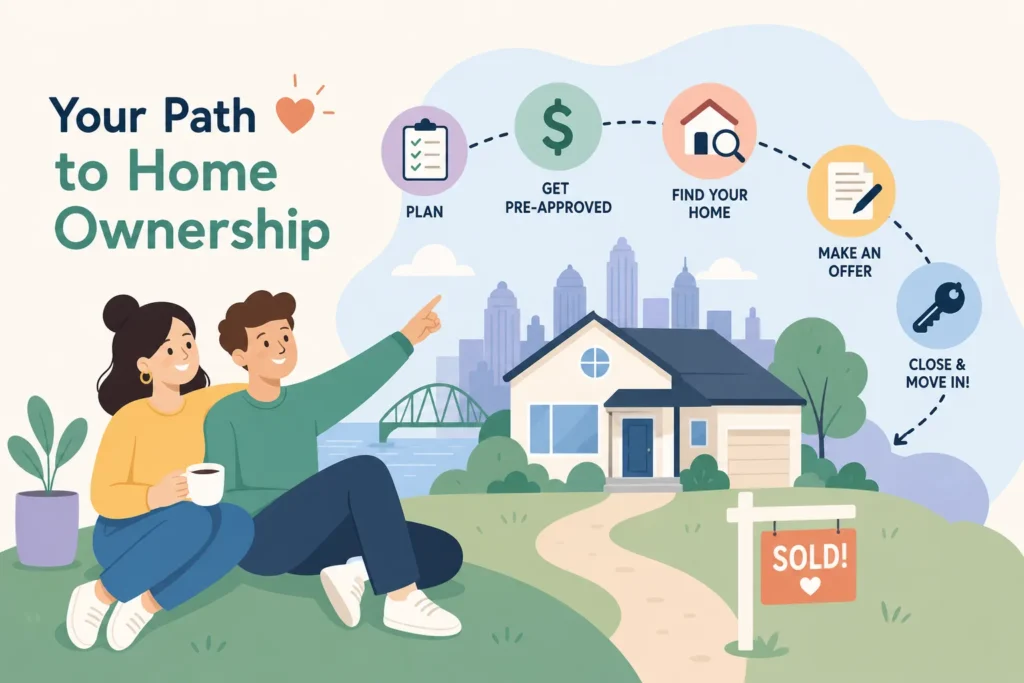
How does the home buying process work in Northeast Ohio? It follows a clear sequence, but most buyers don’t know what that sequence looks like until they’re already in it. That’s when deals fall apart, timelines stretch, and buyers end up stressed over surprises they could have seen coming. Whether you’re shopping in Strongsville, Lorain, or somewhere in between, the core steps are the same: get pre-approved, find a home, make an offer, inspect the property, finalize your financing, and close.
The regional details are where things get complicated. Several Northeast Ohio cities require a municipal point-of-sale inspection before a property can legally change hands. Ohio’s transfer tax hits your closing sheet in ways most buyers don’t anticipate, the state charges $1.00 per $1,000 of sale price, and many Northeast Ohio counties add another $3.00 per $1,000 on top of that, a cost customarily paid by the seller. And if you qualify for OHFA down payment assistance, the documents you need go beyond the standard lender checklist. This guide covers all of it, step by step, so you walk into your home purchase knowing exactly what’s coming.
1. How the Home Buying Process Works in Northeast Ohio: Getting Pre-Approved
What mortgage types Ohio first-time buyers actually use
Ohio buyers have four primary loan options: conventional, FHA, VA, and USDA. Conventional loans require as little as 3% down with a credit score of 640 or higher, but you’ll pay private mortgage insurance (PMI) until you hit 20% equity. FHA loans allow 3.5% down with a minimum credit score of 650 through the Ohio Housing Finance Agency (OHFA). VA loans are available to eligible veterans and active-duty service members with 0% down and no PMI requirement. USDA loans also offer 0% down for buyers purchasing in eligible rural and suburban areas, with a 640 credit score minimum through OHFA.
All four loan types are available as 30-year fixed-rate products through OHFA, which layers state assistance programs on top of the base mortgage. If you’re using an OHFA-backed loan, you’ll also need to complete a homebuyer education course before your loan closes. Ohio mortgage pre-approval through an OHFA-approved lender is the right starting point for most first-time buyers in the region.
Documents lenders need before they say yes
Most lenders want the same set of documents for pre-approval: recent pay stubs, two years of W-2s and federal tax returns, bank statements showing your down payment and reserve funds, a government-issued ID, and documentation for any gift funds you’re receiving. If you’re applying through an OHFA program, expect additional eligibility verification on top of the standard package.
Get pre-approved before you start touring homes. A pre-approval letter gives you a real price range instead of a guess, and it signals to sellers that you’re a serious buyer. In competitive Northeast Ohio markets like Brecksville and Willoughby Hills, sellers don’t wait for buyers who haven’t done this groundwork.
2. Down Payment Programs That Lower What You Owe Upfront
OHFA’s statewide assistance: how it works and what it covers
OHFA’s Down Payment Assistance program provides 3% of the purchase price for conventional loans and 3.5% for FHA, VA, or USDA loans. That money can cover your down payment, closing costs, or other pre-closing expenses, and it’s forgiven after seven years as long as you stay in the home. Two other programs worth knowing: Grants for Grads offers up to 5% of the purchase price for recent college graduates, and Communities First provides a true grant of 3% to 5% with no repayment required under any circumstance.
The distinction between a grant and a forgivable loan matters more than most buyers realize. A true grant never has to be repaid. A forgivable loan is erased after a set period, but if you sell or refinance before that window closes, you owe the balance back. If there’s any chance you’ll move within five to seven years, factor that into which program you choose.
Northeast Ohio-specific programs by county
Cuyahoga County offers one of the more substantial local options: up to 10% of the purchase price for buyers at or below 80% of area median income, structured as a deferred mortgage with partial forgiveness after 10 years. Check directly with the Cuyahoga County Office of Housing for current program terms, as figures and structure can vary by funding cycle. Lakewood has a 0% interest second mortgage program for first-time buyers. Akron provides up to $7,500 for eligible buyers purchasing within city limits. Third Federal’s Home At Last program offers up to $13,000 in forgivable assistance in eligible Northeast Ohio counties after required homebuyer counseling. Verify current availability and eligibility directly with each program, as funding and terms are subject to change.
For Medina and Stark counties, county-level programs are less defined. Buyers in those areas should work directly with an OHFA-approved lender and ask specifically about current availability. Income limits and purchase price limits are set at the county level by OHFA, so eligibility depends on both where you’re buying and your household size.
3. Making an Offer and the Contingencies That Protect You
What a competitive Northeast Ohio offer actually includes
A standard Ohio purchase contract covers offer price, earnest money deposit, proposed closing date, and any seller concessions you’re requesting. Earnest money signals your commitment and is held in escrow until closing. In competitive areas across the Cleveland metro, including Strongsville and Brecksville, buyers sometimes face pressure to increase deposit amounts or shorten contingency windows to stand out. A buyer’s agent who knows local pricing norms is the difference between an offer that gets accepted and one that gets passed over.
Inspection, appraisal, and financing contingencies: don’t skip them
Three contingencies belong in every Northeast Ohio purchase contract. The inspection contingency gives you 10 to 15 days to inspect the home and renegotiate or walk away, though competitive deals sometimes compress that to 5 to 7 days. The appraisal contingency protects you if the bank’s appraiser values the home below the agreed purchase price. The financing contingency protects your earnest money if your loan falls through before closing.
None of these should be waived casually. Each one exists because real problems come up: inspections reveal roof damage, appraisals come in low, loan conditions change. Our approach at Realty Done by Damien Baden is to keep buyers protected while being strategic about what’s negotiable and what isn’t.
4. Northeast Ohio Homebuying Process: What Inspections Actually Look Like
Inspections that go beyond the standard walkthrough
The general home inspection covers the structure, systems, and major components of the property. Beyond that, Northeast Ohio buyers should plan for several targeted inspections based on property type and location. Radon testing is non-negotiable here. Ohio ranks among the higher-radon states, with the Ohio Department of Health estimating that roughly half of all Ohio homes test at or above the EPA action level of 4 pCi/L. Elevated radon is commonly found across Northeast Ohio, including Cuyahoga, Summit, and Lake counties, though exact rates vary by location, consult county radon maps for property-specific context.
Sewer scope inspections are standard practice for older Cleveland-area homes with clay or cast-iron lateral lines. A sewer scope sends a camera through the line to identify root intrusion, collapsed sections, or offset joints before they become a very expensive post-closing problem. FHA and VA loan guidelines require a termite and pest inspection as part of the appraisal and property condition process. For rural and semi-rural properties in Medina, Geauga, or parts of Summit County, a well and septic inspection is required before closing.
Municipal point-of-sale inspections: a Northeast Ohio quirk buyers don’t expect
A number of Northeast Ohio cities require a city-ordered point-of-sale (POS) inspection before a residential property can legally transfer ownership. This list includes Cleveland Heights, Shaker Heights, Euclid, Lakewood, Garfield Heights, and many others across Cuyahoga County and surrounding areas. The POS inspection is a municipal code compliance check, completely separate from the buyer’s private home inspection.
The seller typically initiates the POS inspection, but buyers need to know it exists before they’re under contract. A failed POS inspection can delay or derail a closing if code violations need to be resolved, and some municipalities require an escrow for unresolved repairs before issuing a transfer certificate. A knowledgeable local agent flags POS requirements during the offer stage so nothing catches you mid-transaction.
5. Ohio Closing Costs and Timeline: What You’ll Actually Pay
Breaking down what buyers pay at the closing table
Northeast Ohio buyers typically pay 2% to 5% of the purchase price in closing costs. That covers lender origination fees, title insurance, escrow and attorney fees, prepaid homeowners insurance, property tax escrow, and recording fees. On a home priced at the Cleveland city median of around $150,000, that’s roughly $3,000 to $7,500. On a $279,000 home, which reflects the broader Greater Cleveland median as of mid-2026, per local market data, expect $5,500 to $14,000. Your lender is required to send a Loan Estimate within three business days of your application, breaking down every fee line by line.
Ohio’s conveyance fee and who pays it
Ohio’s real property conveyance fee starts at $1.00 per $1,000 of sale price at the state level. In Cuyahoga, Summit, Lorain, Medina, and Stark counties, the county adds $3.00 per $1,000, bringing the combined rate to $4.00 per $1,000. On a $279,000 home, that’s approximately $1,116 in transfer tax. In Northeast Ohio, this fee is customarily paid by the seller, but it directly affects how much the seller nets from the deal. When you ask for closing cost concessions, understanding the seller’s net position is what makes that conversation go smoothly.
6. The Timeline from Accepted Offer to Keys in Hand
What happens during underwriting and why it takes time
After your offer is accepted, the lender orders the appraisal, the underwriter verifies your income, credit, and assets, and title work runs in parallel. OHFA-backed loans typically target closing 30 to 45 days after the loan application is completed. Conventional loans through private lenders can sometimes move faster. The typical post-contract period across Northeast Ohio runs 30 to 60 days total.
During this time, your job is to stay financially clean. Avoid opening new credit accounts or changing jobs, and respond to every lender document request immediately. Any delay on your end resets the clock and can push your closing date back by days or even weeks.
The final week and what to expect on closing day
“Clear to close” is the milestone that means the underwriter has approved your file and a closing date can be confirmed. You’ll receive the Closing Disclosure at least three business days before closing, showing final numbers for every fee and cost. A final walkthrough of the property happens 24 to 48 hours before closing so you can confirm the home is in the agreed condition.
On closing day, you sign the loan documents, wire the remaining down payment and closing costs, and walk out with the keys. The whole sequence is predictable when your agent, lender, and title company are all communicating clearly and moving without delays.
Ready to Move Forward in Northeast Ohio?
So, how does the home buying process work in Northeast Ohio? Get pre-approved with the right loan type, layer in available assistance programs, make an offer with solid contingencies, complete the right inspections for the property and location, understand your closing costs, and follow through during the 30 to 60 day underwriting period. None of it is complicated once you know what each step requires and when it’s supposed to happen.
Buyers who go in without guidance spend weeks reacting to surprises instead of moving forward on a schedule. At Realty Done by Damien Baden, the focus is on giving you the full picture from the first conversation: what documents to gather, what programs you qualify for, what inspections a specific property needs, and what your cash-to-close number actually looks like before you ever sit at the closing table.
Damien Baden has guided buyers through hundreds of transactions across the Cleveland metro, from new construction purchases in Avon to move-up homes in Hudson and homes across the suburbs ranging from $500,000. If you’re planning to buy in Northeast Ohio, reach out directly to schedule a free buyer consultation. No surprises, no wasted time.
Frequently Asked Questions
How does the home buying process work in Northeast Ohio?
The process follows six core stages: pre-approval, home search, offer and contract, inspections, underwriting, and closing. Northeast Ohio adds regional layers, including municipal point-of-sale inspections in many Cuyahoga County cities, OHFA down payment assistance programs, and Ohio’s conveyance fee at closing. The full timeline typically runs 30 to 60 days from accepted offer to keys.
What is a point-of-sale inspection in Northeast Ohio?
A point-of-sale (POS) inspection is a mandatory municipal code compliance check required by certain cities, including Cleveland Heights, Shaker Heights, Euclid, and Lakewood, before a property can legally transfer ownership. It is separate from the buyer’s private home inspection and is typically initiated upon your offer being accepted.
What down payment assistance programs are available for Ohio homebuyers?
The Ohio Housing Finance Agency (OHFA) offers statewide down payment assistance of 3% to 3.5% of the purchase price, forgivable after seven years. Additional options include the Grants for Grads program, Communities First grants, and county-level programs through Cuyahoga County and cities like Akron and Lakewood. Third Federal’s Home At Last program provides up to $13,000 in eligible Northeast Ohio counties.
How much are closing costs in Northeast Ohio?
Buyers typically pay 2% to 5% of the purchase price in closing costs. On a $279,000 home, near the Greater Cleveland median as of mid-2026, that works out to roughly $5,500 to $14,000. Ohio’s conveyance fee (customarily paid by the seller) adds approximately $4.00 per $1,000 of sale price in most Northeast Ohio counties.
To find out more about how the home buying process works in Northeast Ohio, contact us here today or call/text 440-530-7052
You may find these Realty Done by Damien Baden links helpful
Realty Done By Damien Baden Listings
50 Tips To Sell Your Home Fast in Northeast Ohio
How to win in a multiple offer situation
No BS Home Buying Your Home Buyers Guide
New Construction Home Loans In Ohio
Do you need a realtor when buying new construction?
Realty Done by Damien Baden Client Reviews
Why Use An Agent When Buying Or Selling Your Northeast Ohio House?