Best-Value Northeast Ohio Suburbs for Homebuyers in 2026
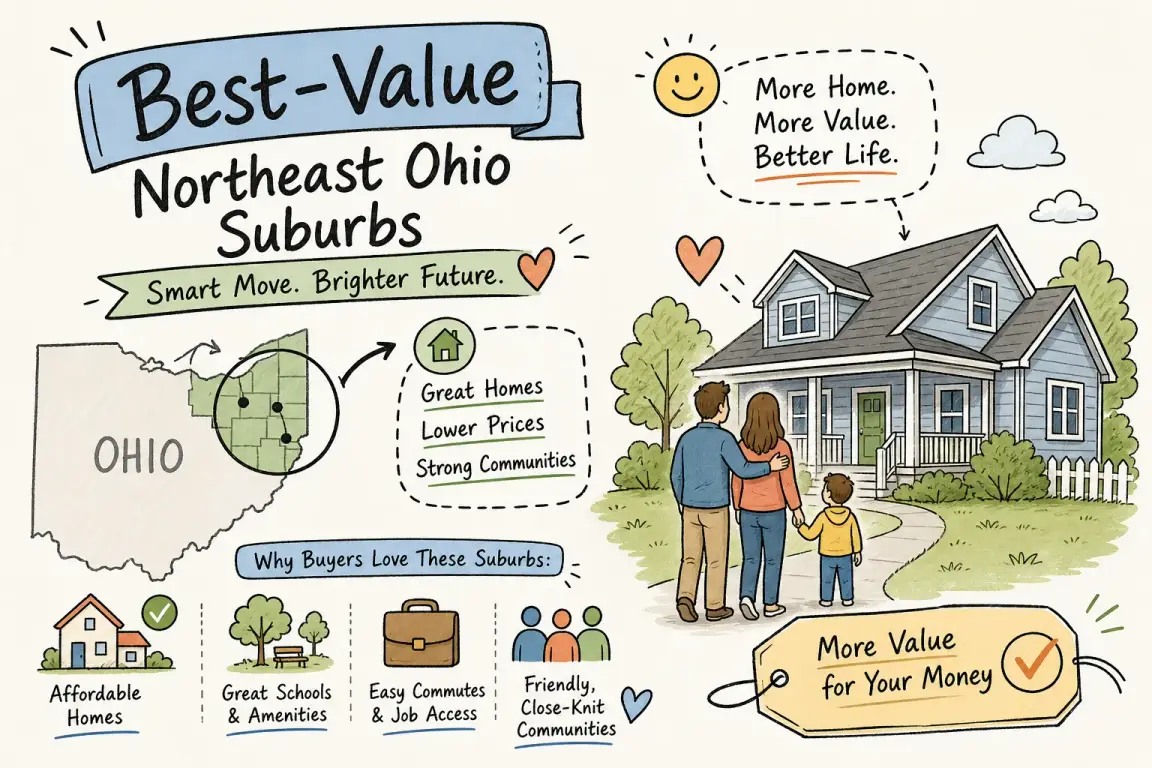
If you’re trying to figure out which Northeast Ohio suburbs have the best home value for the money, start with six markets that consistently hold up across every metric that matters: Strongsville, Broadview Heights, Olmsted Falls, North Royalton, Medina, and Independence. When you evaluate median sale price, price per square foot, school district ratings, property taxes, appreciation trajectory, and commute time side by side, those six separate a genuinely good deal from a home that looks affordable until you run the full monthly cost. This guide uses 2026 market data from Cuyahoga, Summit, Medina, and Lorain counties to score each suburb honestly. The team at Realty Done by Damien Baden has spent 20-plus years watching these specific markets move through cycles, so the commentary here goes beyond what any automated price estimate can tell you.
Whether you’re a first-time buyer working with $280,000 or a move-up family stretching toward $420,000, the suburbs in this guide cover the full competitive range. Read through the framework first, then use the comparison table and tier breakdowns to match your priorities to a specific community.
Key takeaways
- Six metrics matter: Median price, price per square foot, school ratings, property taxes, appreciation rate, and commute time all factor into true value, not just sticker price.
- Best all-around picks: Strongsville, North Royalton, Broadview Heights, and Olmsted Falls offer five-star or near-five-star schools with price-per-square-foot figures at or under $205.
- Affordability leaders: Medina, Brunswick, Cuyahoga Falls, and Parma Heights deliver the most square footage per dollar, especially for remote or hybrid workers.
- Strongest appreciation: Westlake (~39% over five years), Hudson (~32%), and Shaker Heights (~43%) lead long-term equity growth, though their entry prices reflect that track record.
- Hidden gems: Independence and North Ridgeville offer underrated proximity to major employment with lower price floors than their neighbors.
- Next step: Pull 90-day comps, visit on a weekday, and get pre-approved before you schedule showings.
The six metrics that separate a good suburb from a great one
Value in real estate is never just the purchase price. A $250,000 home in a high-tax district with a long commute can cost more per month than a $310,000 home with lower taxes, a five-star school, and a 20-minute drive to work. Running all six metrics side by side is the only way to compare suburbs honestly.
Median sale price vs. price per square foot
Median sale price tells you what the market is doing. Price per square foot tells you what you’re actually getting for it. A $280,000 home at $145 per square foot gives you roughly 1,930 square feet; the same price at $195 per square foot gives you about 1,435 square feet. Across Northeast Ohio, the regional median sat at approximately $260,000 to $265,000 in Q3 2026, so anything under that benchmark with a solid school district warrants a closer look.
School district ratings and property tax burden
Ohio uses a one-to-five-star report card system covering achievement, progress, gap closing, graduation, and early literacy. Five-star districts like Strongsville, Brecksville-Broadview Heights, North Royalton, and Avon Local deliver documented academic outcomes that protect long-term resale demand. Property tax rates complicate the picture significantly: effective rates range from roughly 1.7% in Lake County communities to over 4% in inner-ring eastern suburbs like Shaker Heights and University Heights. A buyer stretching to afford Shaker Heights at $380,000 with a 4% effective tax rate pays approximately $15,200 per year in property taxes; a buyer in Strongsville at $355,000 at roughly 2% pays about $7,100. Those numbers have to sit next to each other for any comparison to be meaningful.
Appreciation rate and commute time
For buyers thinking about equity, the five-year appreciation lens reveals which suburbs have consistently attracted demand. Westlake posted approximately 39% over five years, Hudson roughly 32%, and Shaker Heights about 43%, though Shaker’s tax burden narrows the net equity gain for many buyers. On commute, the practical benchmarks are 20 to 30 minutes to downtown Cleveland or a major employment corridor like the Solon-Twinsburg corporate belt, Hopkins Airport area, or University Circle. Suburbs within that window give buyers maximum lifestyle flexibility without paying an inner-ring premium.
Which Northeast Ohio suburbs have the best home value for the money right now?
The table below compares the six featured suburbs on the criteria that matter most. These figures reflect current 2026 market conditions and serve as planning benchmarks, not appraisals.
| Suburb | Approx. median price | Price per sq ft | School rating | Commute to Cleveland |
|---|---|---|---|---|
| Strongsville | ~$340,000–$370,000 | ~$175–$200 | Five stars | 25–35 min |
| North Royalton | ~$325,000–$375,000 | ~$170–$200 | Five stars | 25–30 min |
| Broadview Heights | ~$316,000 | ~$170–$205 | Five stars (Brecksville-BH) | 20–30 min |
| Olmsted Falls | ~$262,000–$300,000 | ~$160–$190 | 4.5 stars | 25–35 min |
| Medina | ~$285,000–$335,000 | ~$160–$190 | Four stars | 35–50 min |
| Brunswick | ~$285,000–$335,000 | ~$160–$190 | Mid-tier | 30–45 min |
Strongsville and North Royalton: the five-star value corridor
Both suburbs carry five-star Ohio report card ratings, price-per-square-foot figures in the $170 to $200 range, and commutes under 35 minutes to downtown Cleveland. Families get the school outcomes they’re paying for without the tax burden that comes with premium eastern suburbs. Strongsville improved from 4.5 to 5 stars in the 2025–26 report card cycle, a district trending in the right direction rather than coasting on past reputation.
Broadview Heights and Olmsted Falls: where square footage still makes sense
Broadview Heights benefits from Brecksville-Broadview Heights City Schools, a five-star district ranked ninth in Northeast Ohio by the 2025–26 performance index. At a median near $316,000 with price per square foot in the $170 to $205 range, buyers get top-tier academics and commute times of 20 to 30 minutes. Olmsted Falls is a genuine sleeper: the district earned 4.5 stars, the recent three-month median sits around $262,000, and proximity to Hopkins Airport and Westlake employment makes it a strong play for buyers who want a small-town feel without paying Avon prices.
Medina and Brunswick: the affordability anchor
Medina and Brunswick sit at the lower end of this guide’s price spectrum, and that’s a feature, not a compromise. Median prices in the $285,000 to $335,000 range with price-per-square-foot figures around $160 to $190 mean buyers get substantially more home. The trade-off is a longer drive: Medina runs 35 to 50 minutes to downtown Cleveland, Brunswick about 30 to 45. For remote or hybrid workers who commute two or three days a week, that math shifts dramatically in favor of these communities.
Where is home equity growing the fastest?
Buyers focused on long-term equity need to separate the sustained five-year performers from the recent single-year accelerators, because the two lists don’t always overlap. A suburb with a spectacular one-year jump may simply reflect a shift in what type of homes sold, not a fundamental change in demand.
Five-year leaders in highest home appreciation among Cleveland suburbs
Westlake posted approximately 39% appreciation over five years with a median around $368,000 and a five-star school district. Hudson showed roughly 32% over the same window and positions buyers well for Akron employment, typically 20 to 25 minutes away. Shaker Heights recorded about 43% over five years, which is impressive on paper, but its effective property tax rate near 4% of market value meaningfully reduces net equity gain for most buyers. These markets have earned their premium prices; the question is whether the entry price leaves room for the next buyer to build equity at a similar rate.
Recent acceleration: which suburbs are moving right now
For buyers watching 2026 momentum, Pepper Pike showed roughly 44% year-over-year median price growth in Cuyahoga County data, though its $500,000-plus price floor limits who can participate. Bay Village gained approximately 21% year-over-year at a more accessible $400,000 to $500,000 range, backed by a five-star school district. Those single-year figures partly reflect a shift in sales mix, specifically, more high-end closings and fewer entry-level transactions moving through the market, so weigh them alongside the longer five-year trend before treating them as a reliable growth signal.
Hidden-gem suburbs most buyers skip right over
This is where 20-plus years of market experience earns its keep. The suburbs below don’t carry the brand recognition of Strongsville or Westlake, but their fundamentals are strong and buyer competition is lower. That combination creates windows of real opportunity.
Independence and Parma Heights: underrated proximity plays
Independence is one of the most overlooked commuter values in the region. Median prices sit around $309,000, the commute to downtown Cleveland runs only 15 to 20 minutes via I-77 and I-480, and buyers gain access to multiple employment corridors without paying Strongsville or North Royalton prices. Parma Heights offers even lower entry points in the $250,000 to $300,000 range with price per square foot around $155 to $185, putting it within 25 minutes of downtown for buyers whose primary constraint is purchase price.
North Ridgeville and Cuyahoga Falls: value plays outside Cuyahoga County
North Ridgeville in Lorain County runs $300,000 to $350,000 at the median, sits adjacent to Avon Local Schools (a five-star district), and gives buyers access to Avon and Westlake employment without paying Avon’s $390,000 to $450,000 price floor. Its effective property tax rate of approximately 1.5% to 1.8% is among the more favorable in this entire guide. Cuyahoga Falls in Summit County runs $220,000 to $275,000 at the median, among the most affordable communities covered here, with easy access to Akron’s employment base for buyers priced out of Hudson.
How to find which Northeast Ohio suburbs have the best home value for the money in your budget
Matching the right suburb to your actual finances means going beyond purchase price. Property tax burden alone can shift your effective monthly cost by hundreds of dollars, which changes where your real ceiling sits before you ever schedule a showing. Use the tier structure below to narrow your list first.
Under $300,000: where affordability still has options
Focus on Parma Heights, Cuyahoga Falls, and Brunswick. These markets deliver the most square footage per dollar in Northeast Ohio and attract less competition than comparable inner-ring suburbs. School district quality varies across this tier, so families with school-age children should research Cuyahoga Falls (solid) and Brunswick (mid-tier) carefully before committing. Property taxes are generally moderate, which helps the monthly payment math work at this price point.
$300,000 to $420,000: the competitive sweet spot
This is where the most compelling best-value Northeast Ohio suburbs cluster. Broadview Heights, Olmsted Falls, Strongsville, North Royalton, Medina, North Ridgeville, and Independence all fall within or near this band. Buyers in this range can access five-star school districts, commute-friendly locations, and competitive price-per-square-foot figures without crossing into the premium market. Inventory is tighter here than in the under-$300,000 tier, so move-in-ready homes at fair prices require speed and a genuine pre-approval letter in hand before you tour.
Above $420,000: premium suburbs with long-term equity arguments
Westlake, Hudson, Avon, Bay Village, and Aurora serve buyers who can carry a higher purchase price and want the strongest combination of school quality, neighborhood stability, and appreciation trajectory. These markets have outperformed the regional median over five years and attract financially stable buyer pools, which protects values even when broader market conditions soften. The entry price is higher, but so is the floor.
What 20+ years of market experience reveals that the data doesn’t show
Public metrics show where prices are. Experienced local agents know whether a suburb is gaining momentum or plateauing after a strong run. Factors like new commercial development along a corridor, recent school levy vote history, and infrastructure investment often predict a suburb’s next five years more accurately than its last five. A community that just passed a major levy is signaling resident confidence in long-term value; one that has rejected three consecutive levies is telling you something different.
The Realty Done by Damien Baden team covers the full corridor from Avon to Hudson, which means current, ground-level data across every suburb in this guide, not just county-level market reports pulled from a dashboard. When you’ve narrowed your list to two or three communities, a conversation with Damien can sharpen that shortlist with current comps, days-on-market trends, and a realistic picture of what your budget actually gets you in each specific neighborhood, not just the zip code.
The next three steps once you’ve identified your target suburbs
Pull active comps from the last 90 days in each suburb you’re considering. That single action tells you whether the market is tightening or softening, how quickly homes are moving, and whether asking prices are landing at or above list. Then visit your top two or three communities on a weekday morning to get an honest read on commute feel, neighborhood activity, and whether the daily reality matches the online listing photos. Finally, get fully pre-approved before you schedule showings with a listing agent. In the competitive $300,000 to $420,000 band, buyers who arrive with a pre-approval letter move faster and negotiate from a stronger position. Reach out to the Realty Done by Damien Baden team to access current MLS Now listings across the region and get a clear-eyed assessment of where your budget positions you today.
The bottom line on Northeast Ohio suburb value
Ultimately, if you’re searching for which Northeast Ohio suburbs have the best home value for the money, the answer depends on where your specific budget, school priorities, commute tolerance, and equity goals all converge, there is no single universal pick. For buyers under $300,000, Parma Heights, Cuyahoga Falls, and Brunswick are the strongest starting points. From $300,000 to $420,000, the competitive tier of Strongsville, North Royalton, Broadview Heights, Olmsted Falls, Independence, and North Ridgeville represents the densest concentration of value in the entire region. Above $420,000, Westlake, Avon, Bay Village, and Hudson carry the long-term equity argument backed by five years of data.
What separates buyers who land the right home from those who overpay or end up in the wrong suburb is almost always local knowledge paired with honest guidance. Realty Done by Damien Baden exists to provide exactly that: straight talk, current market data, and 20-plus years of Northeast Ohio experience applied to your specific situation. When you’re ready to move from research to action, get in touch with the team and put that framework to work on a real purchase.
Frequently Asked Questions
How should a remote or hybrid worker weigh commute time against price per square foot when choosing a suburb?
Prioritize price per square foot and square footage over commute time if you work remotely most days. For remote or hybrid workers, markets like Medina, Brunswick, Cuyahoga Falls, and Parma Heights deliver the most square footage per dollar and can offset a longer commute two or three days a week. If you need frequent in-person presence, keep to the 20–30 minute window to downtown Cleveland or major corridors to preserve lifestyle flexibility.
How much do property taxes actually change your monthly housing cost between suburbs?
Property taxes can shift your effective monthly cost by hundreds of dollars and materially change which price point you can afford. For example, a $380,000 purchase in a 4% effective tax district results in roughly $15,200 per year in taxes versus about $7,100 per year on a $355,000 purchase at roughly 2%. Always run taxes next to mortgage, insurance, and HOA (if any) when comparing monthly payments.
Can I estimate home size from price and price per square foot, and how accurate is that method?
Yes, you can estimate square footage by dividing price by price per square foot, but treat it as a rough guide. For instance, a $280,000 home at $145/ft² implies about 1,930 ft² while the same price at $195/ft² implies about 1,435 ft². Use that calculation to screen listings, then verify actual square footage on the listing and in the inspection before making offers.
How should families prioritize five-star school districts versus long-term appreciation when choosing a suburb?
Families should weigh five-star schools heavily for resale demand, but also consider tax burden and appreciation to judge net equity. Five-star districts like Strongsville, Brecksville-Broadview Heights, and North Royalton protect long-term resale demand, while high-appreciation markets such as Westlake and Hudson have earned premiums that may limit entry and tax-adjusted gains. Match school priorities to your budget band, under $300k, $300k–$420k, or above, to find the right balance between schools and equity.
To find out more about best value homes in Northeast Ohio, contact us here today or call/text 440-530-7052
You may find these Realty Done by Damien Baden links helpful
Realty Done By Damien Baden Listings
50 Tips To Sell Your Home Fast in Northeast Ohio
How to win in a multiple offer situation
No BS Home Buying Your Home Buyers Guide
New Construction Home Loans In Ohio
Do you need a realtor when buying new construction?
Realty Done by Damien Baden Client Reviews
Why Use An Agent When Buying Or Selling Your Northeast Ohio House?
