

Is it time to cash in your chips? Here is everything you need to know about offloading your rental portfolio in the Cleveland, Akron, and Canton markets without the headache.
Being a landlord in Northeast Ohio isn’t for the faint of heart. Between the late-night maintenance calls, navigating Ohio’s changing tenant laws, and managing property taxes, even the most seasoned investor reaches a breaking point. You might be sitting on significant equity after the recent market appreciation, or perhaps you are simply tired of the “Three T’s” (Tenants, Toilets, and Taxes).
At Realty Done by Damien Baden, we don’t believe in fluff. We believe in getting you from Point A (landlord) to Point B (cashed out) safely, efficiently, and with the highest possible return. This guide serves as your regional blueprint for selling rental property in Northeast Ohio.
The “Stay or Go” Analysis: Northeast Ohio Market Context
Before you put a sign in the yard, you need to understand the terrain. The Northeast Ohio real estate market—spanning from the shores of Lake Erie down to Canton—has shifted.
Current Market Climate
We are currently in a unique “stabilization phase.” While the frantic bidding wars of the early 2020s have cooled slightly, Northeast Ohio remains a seller’s market due to a persistent inventory shortage.
- Inventory Levels: Still historically low, particularly for multi-family units and “rent-ready” single-family homes in suburbs like Strongsville and Parma.
- Buyer Demand: There is a surge of out-of-state investors looking for cash flow in the Midwest, meaning your rental property is a hot commodity—if priced and marketed correctly.
- The Opportunity: With prices stabilizing, many landlords are choosing to sell now to capture their appreciation gains before potential regulatory changes or major capital expenditure (CapEx) repairs (like a new roof or HVAC) eat into their profits.
Realty Done Insight: If your property requires significant updates (maintenance deferred during tenancy), you have two choices: sell “as-is” to an investor or execute strategic renovations to target owner-occupants. We help you run the numbers to see which yields the higher net.
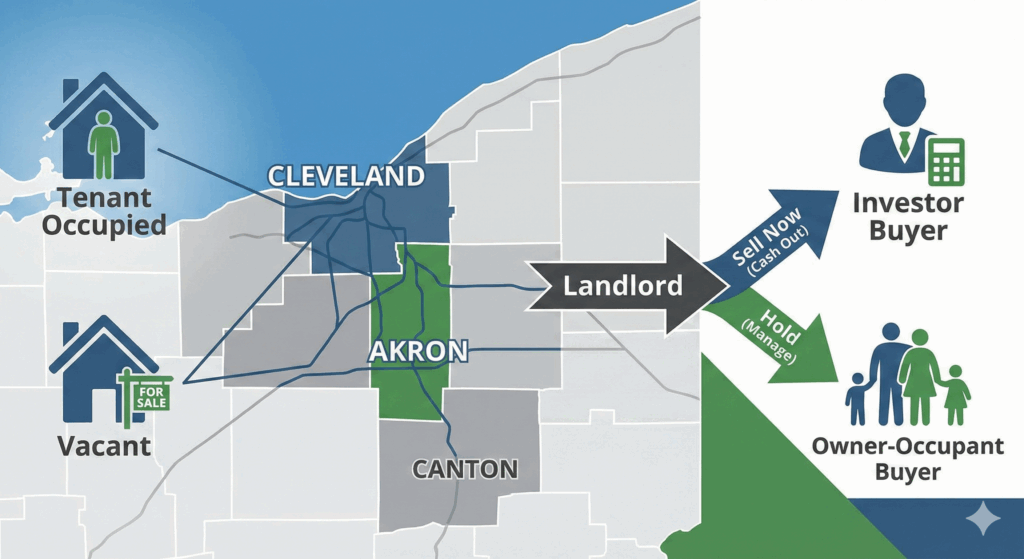
The Tenant Dilemma: Selling Occupied vs. Vacant
The number one question we get at Realty Done is: “Can I sell my house if the tenant is still living there?”
The short answer is Yes. But the how matters immensely.
Ohio Landlord-Tenant Laws
In Ohio, the lease survives the sale. This means if you sell a duplex in Lakewood with six months left on a lease, the new buyer inherits that tenant and that lease. You cannot simply kick a paying tenant out because you want to sell, unless the lease has a specific “termination on sale” clause (which is rare).
Your Options
- Sell to an Investor (Tenant Remains): This is often the path of least resistance. Investors love “turnkey” properties with paying tenants in place. It shows immediate cash flow.
- Wait for Lease Expiration: You issue a non-renewal notice (typically 30 days in Ohio for month-to-month) and sell the unit vacant. This opens your buyer pool to owner-occupants who might pay a premium to live there themselves.
- “Cash for Keys”: If you need the unit vacant to sell for top dollar (common in higher-end neighborhoods like Westlake or Solon), you can negotiate a voluntary move-out with the tenant in exchange for a financial incentive.
The Showing Protocol
Under Ohio law, you must provide reasonable notice (standard is 24 hours) before entering a tenanted property for showings.
- The Realty Done Standard: We don’t just stick a lockbox on the door and hope for the best. We communicate directly with tenants to ensure they feel respected, not displaced. A cooperative tenant keeps the house clean; an angry tenant can sabotage a sale.

The Financial Impact: Taxes and Capital Gains
Selling a rental isn’t like selling your primary residence. The tax man is watching, but proper planning can save you thousands.
Capital Gains Tax
You will likely owe federal capital gains tax (0%, 15%, or 20% depending on income) on the profit. Ohio also treats capital gains as regular income, subject to state income tax brackets.
The Hidden Cost: Depreciation Recapture
This is the one that catches most landlords off guard. If you have been claiming depreciation on your taxes (as you should have), the IRS will “recapture” that depreciation upon sale and tax it at a rate of up to 25%.
The Loophole: 1031 Exchange
If you plan to reinvest the proceeds into another investment property (perhaps upgrading from a C-class rental in Cleveland to a B-class apartment building in Medina), you can use a 1031 Exchange. This allows you to defer all capital gains taxes.
- Note: This requires a Qualified Intermediary and strict timelines (45 days to identify a new property, 180 days to close). We can connect you with local experts to handle this.
Neighborhood nuances: Where is the Demand?
Real estate is hyper-local. A rental strategy that works in Ohio City will fail in Avon. Here is what we are seeing across the region:
| Area | Buyer Profile | Strategy |
| Cleveland (Ohio City, Tremont) | Young Professionals / Airbnb Investors | High Appreciation. Sell on the “lifestyle.” Ideally sold vacant or staged. |
| Inner Ring Suburbs (Parma, Lakewood) | First-Time Buyers / Portfolio Builders | Stability. These move fast. If updated, target owner-occupants. If dated, target investors. |
| Outer Ring (Strongsville, Westlake) | Families / High-End Renters | Premium Pricing. Tenants must be well-managed during sale. Best sold to owner-occupants. |
| Akron / Canton | Cash Flow Investors | ROI Focused. Buyers care about the “Cap Rate” and rent rolls. Condition is secondary to the numbers. |
The Realty Done Blueprint
Damien Baden is a pilot, and he approaches real estate with the same checklist-driven safety protocols used in aviation. We don’t “wing it.”
Step 1: The Audit
We review your lease agreements, rent rolls, and property condition. We identify the “deal killers” before a buyer ever sees them.
Step 2: The Positioning
We decide on the narrative. Are we selling “Potential” (a fixer-upper for an investor) or “Performance” (a steady income stream)? We use professional video and targeted digital marketing to reach the right audience—whether that’s a local buyer or a hedge fund in California.
Step 3: The Vetting
Not all cash offers are real. We verify proof of funds and vet buyers aggressively to ensure they don’t tie up your property only to ask for a $20,000 price reduction a week before closing.
Conclusion: Safe Landing
Selling a rental property involves moving parts that don’t exist in a standard home sale. You have tenants to manage, tax implications to calculate, and a market to navigate. You need a partner who speaks the language of ROI and understands the emotional reality of parting with an asset.
Are you ready to stop being a landlord and start being a seller?
Your Next Step
Don’t guess what your rental is worth in today’s shifting market. Click here to request a Free, No-Obligation “Rent vs. Sell” Analysis. We will look at your specific property, current rents, and equity position to give you a “No B.S.” recommendation on your best move.
Disclaimer: Realty Done by Damien Baden is a real estate brokerage team. We are not tax advisors or attorneys. Please consult your CPA or legal counsel regarding specific tax implications and tenant laws.