

Northeast Ohio Real Estate: The Complete 2026 Market Guide
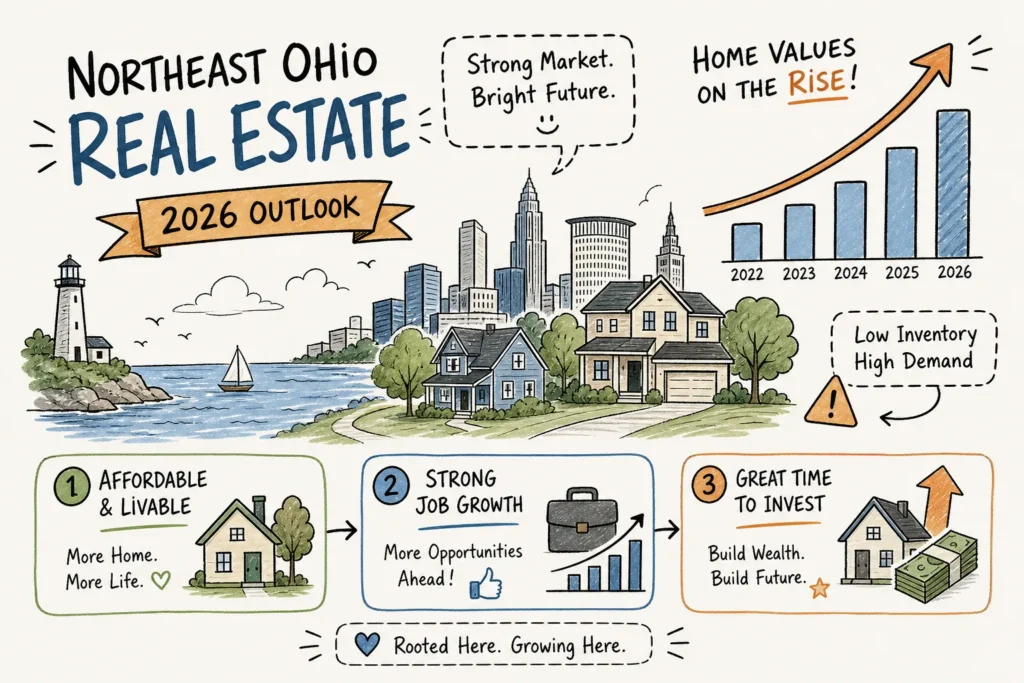
The Northeast Ohio real estate market in fall 2026 is not what most outside observers expect. Median prices are climbing, inventory remains tight across the five-county core, and buyers in the right suburbs are facing multiple-offer situations even as national headlines point to slowing sales volume in coastal metros. This guide cuts through the noise with data pulled directly from regional MLS reports and local market activity. Whether you are buying your first home in Cleveland, upgrading to Hudson, or listing a luxury property in Bay Village, here is exactly where the market stands right now and what you should do next.
One thing becomes clear quickly when you study Northeast Ohio: this is not a single market. It is a collection of micro-markets that move at different speeds and very different price levels. A buyer searching in Lakewood operates in a completely different environment than one searching in Canton or Medina. Understanding those distinctions is the difference between a smart move and an expensive miscalculation.
Where the Northeast Ohio housing market stands in fall 2026
The core five-county region, covering Cuyahoga, Lorain, Medina, Lake, and Summit counties, currently holds approximately 6,300-plus active listings, according to MLS Now data through Q3 2026. A broader regional measure that captures single-family homes across the wider Northeast Ohio area shows roughly 9,812 active listings from the same reporting period. Both figures point to the same reality: supply is present but not abundant, and the market is not handing sellers or buyers an easy advantage.
A 2.6-to-3-month supply sounds manageable, but context matters. A balanced market sits around six months of supply. At under three months, sellers still hold meaningful leverage across most price ranges, even if the frantic pace of 2021 and 2022 has eased. Per MLS Now market reports through Q3 2026, days on market ranges from 34 to 58 days depending on price point, suburb, and property condition. Citing a single regional average misleads buyers because a home in Lakewood and a home in a rural Lake County township are not competing in the same pool.
Nationally, coastal markets have cooled and inventory has risen in many metros. Northeast Ohio tells a different story. The regional median sale price of approximately $260,000 to $265,000 sits notably below the national median of roughly $274,855 (NAR, Q3 2026). That affordability gap continues to pull relocation buyers toward the Cleveland metro from higher-cost markets, adding demand that local inventory is still working to absorb. For any buyer or seller trying to interpret national real estate news, the takeaway is straightforward: what is happening in Los Angeles or Austin is largely irrelevant to what you will face in Cuyahoga County this fall.
Northeast Ohio real estate: home prices by suburb and county
City and inner-ring suburb medians
Cleveland’s median sale price sits around $149,901 over the most recent three-month window (MLS Now, Q3 2026), while Cuyahoga County’s median listing price comes in around $234,517. That gap is not a data error. Inner-ring suburban demand, places like Rocky River, Lakewood, and Solon, pulls the county figure well above the city median. Buyers working within Cleveland’s city limits will find accessible entry points, but listing prices in city neighborhoods span from approximately $77,900 to $384,125 depending on the specific ZIP code. Neighborhood-level data matters far more than city-wide averages here.
County-level medians
Akron’s median listing price runs around $139,900, with Summit County overall at approximately $227,450. Canton and the broader Stark County area represent one of the region’s more accessible entry points for buyers stretching their dollars. The blended Northeast Ohio regional median sale price of $260,000 to $265,000 is a useful reference point for headline comparisons, but it smooths over enormous variation. For any buyer working toward a specific suburb or price target, a hyperlocal comparable sales analysis delivers the actionable picture that county medians cannot.
Mortgage rate impact on purchasing power
Mortgage rates add another layer of calculation for 2026 buyers. Current 30-year fixed rates in Ohio sit around 7.0%, with lender quotes ranging from approximately 6.96% to 7.13% depending on credit profile and down payment (Bankrate and NerdWallet rate surveys, September 2026). At those rates, the difference between a $250,000 purchase and a $300,000 purchase translates to a meaningful monthly payment gap, which is why knowing the true comparable sale price in your target neighborhood before you start writing offers is not optional.
Suburbs and neighborhoods with the strongest momentum right now
Lakewood stands out as one of the fastest-moving pockets in the entire northeast Ohio real estate market. Homes there are averaging around 8 days on market, with multiple offers common on well-priced listings (MLS Now, Q3 2026). Its Lake Erie proximity, walkable restaurant corridors, and strong community identity continue to drive steady buyer demand well beyond what inventory can comfortably absorb. If you are targeting Lakewood, being pre-approved and ready to move within 24 to 48 hours of a new listing is not overcautious, it is necessary.
Garfield Heights drew attention in 2026 as a first-time buyer market, driven by lower median pricing and strong access to regional employment. Realtor.com’s mid-year market analysis flagged it among Ohio markets showing the strongest affordability-to-demand ratios. On the appreciation side, the ZIP-level leaders across the region include Maple Heights, Euclid, Parma, Parma Heights, Bedford, and South Euclid, all showing meaningful year-over-year median sale price growth per MLS Now data through Q3 2026. Willoughby posted one of the stronger year-over-year sale price increases in the state, around 26% through August 2026, making it worth attention for both buyers and sellers evaluating timing.
At the premium end, Bay Village, Rocky River, Westlake, Solon, Shaker Heights, and Pepper Pike continue to draw sustained buyer interest. Bay Village posted year-over-year median sale price appreciation of approximately 21% (MLS Now, through August 2026), and Pepper Pike led Cuyahoga County suburbs at around 44% over the same period. Hudson deserves particular attention as the suburb leading the region on year-over-year resale price growth, making it both a strong appreciation play and a competitive environment for move-up buyers. Outside of Cuyahoga County, Avon, North Ridgeville, and Brunswick are emerging as growth corridors with consistent sales volume increases.
Property taxes, school districts, and what actually drives long-term value
Some of the most desirable Northeast Ohio suburbs also carry some of the highest effective property tax rates in the country. Shaker Heights runs approximately $3,500 to $3,900 per $100,000 of assessed home value, with roughly 73% of that bill flowing directly to the school district (Cuyahoga County Treasurer, 2026). At the county level, Cuyahoga’s effective rate sits around $2,080 per $100,000, compared to Summit County at $1,540, Lorain at $1,440, and Medina at $1,290. That spread makes a real difference in monthly carrying costs, especially at higher price points.
School district boundaries often matter more than city names when pricing a home in Northeast Ohio. Four suburbs come up repeatedly in family-focused searches:
- Shaker Heights: Nationally recognized schools, historic architecture, walkable corridors, and strong transit access. High taxes are the tradeoff, but demand remains consistent for buyers who prioritize the school district and the neighborhood character.
- Lakewood: A strong urban district reputation, Lake Erie access, and some of the best walkability and restaurant density in the region. Tax rates are high but generally below Shaker Heights levels.
- Hudson: A five-star rated district on the Ohio State Report Card, a charming historic downtown, strong community identity, and premium resale values. This is the suburb that consistently draws move-up buyers who want top-performing schools without giving up suburban livability.
- Medina: More moderate tax burden than the inner-ring premium suburbs, solid family-oriented schools, a walkable public square, and a genuinely accessible entry point into the quality-suburb tier of the Northeast Ohio market.
Always run the tax numbers on your specific target address, not just the city or suburb name. Two streets in the same city can sit in different school districts with meaningfully different tax bills attached.
Where to find Northeast Ohio homes for sale: listings and search strategy
MLS Now, sometimes referenced as YES MLS, is the regional database that powers listing data for Cleveland, Akron, Canton, Lorain, Cuyahoga County, and the surrounding counties. Every local brokerage site and most national portals feed from this same source. When you are searching on Zillow or Trulia, you are often looking at data that is hours or even days behind the actual MLS feed, which matters significantly in fast-moving markets like Lakewood where homes can clear in under two weeks.
A smarter search sequence: start with a local brokerage site running a live MLS Now IDX feed for the freshest data. Cross-check Realtor.com and Zillow for saved search alerts and secondary coverage. Use suburb-specific or county-specific filters rather than broad regional searches to cut through noise and surface relevant results faster. Working directly with an agent who has full MLS access takes this further. In some cases, you get notified before a listing even reaches public portals, which in a sub-10-day market like Lakewood is a material advantage. Buyers searching for houses for sale near Akron or in the outer-ring Cuyahoga suburbs will find that hyperlocal MLS access narrows the search and sharpens the timing.
What to do next: practical steps for buyers and sellers in 2026
Before you tour a single home, three questions should already have clear answers. What is your realistic price ceiling including property taxes in your target suburb, not just the purchase price? Are you buying contingent on selling your current home, or do you come to the table as a clean buyer? Do you understand how school district boundaries affect resale value in the specific neighborhood you are targeting? Buyers who work through these questions before they start scheduling showings move faster and lose fewer deals to better-prepared competitors.
An algorithm can surface thousands of active northeast Ohio real estate listings across the region. It cannot tell you that a specific subdivision in Avon has an HOA change coming that will affect resale value, or that a particular street in Strongsville consistently draws multiple offers within 72 hours of going live. That kind of pattern recognition comes from years of transactional experience in a specific market, not from a portal filter. Realty Done by Damien Baden has closed more than 600 transactions across Northeast Ohio over a 20-year track record, covering communities from Avon and Bay Village to Hudson and Medina.
For sellers who need aggressive, high-visibility marketing, the gap between a mass-exposure digital strategy and a standard MLS listing shows up at the closing table. Video walkthroughs and 3D tours reach qualified buyers who never would have found a listing through a basic portal search, and targeted digital campaigns consistently drive higher offer volume on comparable properties. For buyers relocating to the region or navigating a simultaneous sale and purchase, having an agent who understands the contingency landscape and builder contract nuances across Northeast Ohio removes the guesswork from what is already a high-stakes transaction.
Frequently asked questions about Northeast Ohio real estate
What is the median home price in northeast Ohio right now?
The regional median sale price across the five-county core sits at approximately $260,000 to $265,000 as of Q3 2026, according to MLS Now reporting. That figure varies significantly by county and suburb, Cleveland city medians run closer to $149,901 while premium suburbs like Hudson and Bay Village push well above the regional average.
How long does it take to sell a home in northeast Ohio?
Days on market ranges from 34 to 58 days across the broader region, but fast-moving suburbs like Lakewood average closer to 8 days. Price point, suburb, and property condition all affect that number significantly.
Is northeast Ohio a buyer’s or seller’s market in 2026?
With supply hovering between 2.6 and 3 months across the five-county core, sellers retain a meaningful edge in most price ranges and desirable suburbs. Some outer-ring and higher-price-point segments offer buyers slightly more negotiating room, but inventory has not shifted enough to call this a balanced market region-wide.
The bottom line on Northeast Ohio real estate in 2026
Northeast Ohio real estate in 2026 is a market of sharp contrasts. Cleveland city prices stay accessible while Hudson and Bay Village push premium values higher. Lakewood clears inventory in roughly 8 days while the broader region averages 34 to 58 days. MLS Now is the source of record while most buyers are still relying on lagging national portals. Understanding these distinctions is the difference between a smart move and an expensive mistake.
Whether you are searching for homes in Cuyahoga County, comparing suburbs for schools and taxes, or getting ready to list a property, the next step is the same: connect with someone who knows this market at street level, not just county averages. Realty Done by Damien Baden is that resource. Reach out to Damien directly to get a current market analysis for your specific neighborhood and price range, and walk into your next transaction with real data behind every decision.